Budget overruns, domestic loans risk eroding fiscal credibility
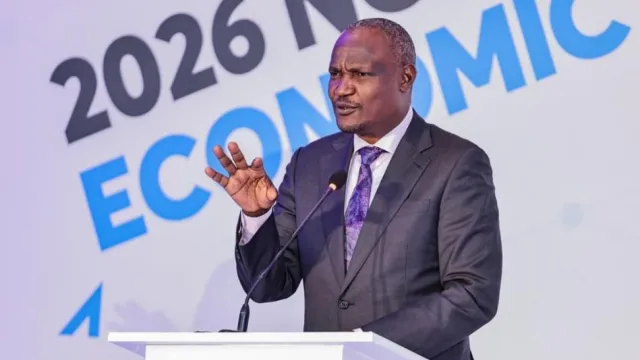
National Treasury Cabinet Secretary John Mbadi. In its latest Kenya Economic Update report, the World Bank notes that the country's shift toward domestic financing is deepening the "sovereign-bank nexus," increasing lenders' exposure to government debt and raising the risk that government borrowing will crowd out credit to the private sector.
President William Ruto's administration continued reliance on domestic borrowing to meet needs of budget overruns risks eroding Kenya's hard-worn macroeconomic stability, the World Bank has warned.
In its Kenya Economic Update report released on Wednesday, the World Bank faulted the government for its failure to adhere its budgetary targets noting that this trend is worsening the fiscal deficit, rise in domestic borrowing amid debt service woes.
Related
Kenyan families are getting smaller, new KNBS study shows
High fuel costs strain households as October inflation rises to 7.3%

The Washington-based lender noted that fiscal managers in Nairobi have been caught in a vicious cycle, where increasingly, the cost of servicing debt obligations is crippling the ability of the government to spend on priority areas that spur future growth.
For instance, during the fiscal year 2025/2026, the World Bank highlights that Kenya's fiscal deficit hit 6.8 percent of the GDP, outpacing a target of 4.7 percent and the FY2024/25 outturn of 6 percent.
The lender noted that this mismatch was not as a result of any economic shock but rather a failure on the part of policymakers to put checks on expenditure while also making accurate projections on revenue collections.
Kenya Economic Update report states that the country approved two supplementary budgets during the year, pushing up total expenditure to 24.1 percent of the GDP against a projected 22.2 percent.
At the same time, revenue collections fell short of target, with the taxman collecting about 17.3 percent of the GDP.
"Repeated slippages weaken fiscal credibility and constrain fiscal consolidation efforts," the World Bank warns, pointing out that supplementary budgets have increasingly become a routine feature of budget execution rather than an exceptional measure for genuine emergencies.
According to the World Bank, the persistent gap between the approved budgets and the actual outturns, continues to make it harder for East Africa's largest economy to maintain a credible path of fiscal adjustment.
The report notes that in recent years, Dr. Ruto's administration has embraced domestic borrowing and the primary source of funding budget needs. In the FY2025/26 for instance, statistics show that domestic borrowing hit 5.3 percent of the GDP, being 2.1 percentage points higher than budgeted by policymakers.
Owing to increasing domestic borrowing, local debt now accounts for 56.2 percent of the country's loan obligations, even as gross public debt edged to 69.9 percent of GDP as at 30th June this year.
The World Bank report notes that the country's shift toward domestic financing deepens the "sovereign-bank nexus," increasing banks' exposure to government debt and raising the risk that government borrowing will crowd out credit to the private sector.
The report notes that while financial conditions eased and private sector credit growth reached 10.6 percent in September 2026, the heavy reliance on domestic debt to fund the state’s consumption remains a structural vulnerability.
Despite a decline in external debt driven by lower external borrowing and exchange rate stability, the sheer volume of domestic debt means interest payments remain elevated.
Kenya's debt service costs reached 5.8 percent of GDP in FY2025/26, largely due to the growing share of domestic debt. This means that interest payments alone are now absorbing a staggering 33.6 percent of government revenues, severely limiting fiscal space for development spending on health, education, and infrastructure.
World Bank noted that while commercial bank lending rates declined to 14.4 percent in September 2026, the government’s heavy domestic borrowing appetite continues to exert upward pressure on interest rates.
This, in turn, constrains the availability of affordable credit to the private sector, undermining the investment needed to stimulate growth.