Kenyan families are getting smaller, new KNBS study shows
Amid the decline in number of children per family, families are experiencing a widening birth interval, currently at 46.3 months or nearly four years.
The number of children in Kenyan families are getting fewer even as the number of months between births widens, official data released by the Kenya National Bureau of Statistics (KNBS) on Tuesday shows.
According to the 2025-26 Kenya Mini Demographic and Health Survey (KMDHS) published by the KNBS and the Ministry of Health, the country's total fertility rate has dipped to 3.1 children per woman currently from a higher 3.4 children per woman reported in 2022.
Related
Couple approach to fertility challenges enhances outcomes
Kenya gets 450,000 self-injectable contraceptives doses

An estimated "43 percent of women aged 15-49 do not want another child," the study noted in part.
Amid the decline in number of children per family, families are experiencing a widening birth interval, currently at 46.3 months or nearly four years.
What's more, the "percentage of women age 15-19 who have ever been pregnant fell from 14.8 percent to 11.9 percent," the report states in part.
The study further noted that the country's population is experiencing persistent gaps between the desired and actual size of families.
The survey data was collected between 5 November 2025 and 10 February 2026, using a nationally representative sample of 29,935 households drawn from the Kenya Household Master Sample Frame, said KNBS Director-General Macdonald Obudho.
However, whereas the wanted fertility rate is 2.7 children per woman, the total fertility rate stands at 3.1, implying that the average Kenyan woman could be having more children than they actually desire.
Family planning initiates
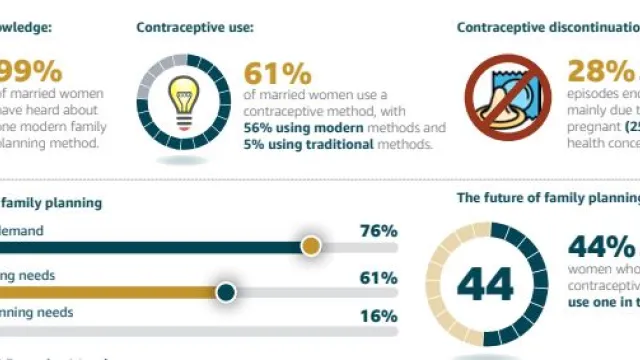
Meanwhile, in terms of family planning initiatives, the survey found that just over six in every 10 women are using a contraceptive method even as 56 percent of the women opting for modern methods of birth control.
The statistics revealed that an estimated 28 percent of contraceptive-use episodes ended within a year, attributable to the desire by users to get pregnant (25 percent) and a similar percentage due to side effects and or concerns on the health of the users.
Another highlight of the study was the emergence of tech-based gender based violence where 22 percent of women reported experiencing it in the last one year.
Currently, among the married women, husbands or intimate partners account for 61 percent of tech-facilitated violence. Online attackers account for 23 percent of the cases while for the never-married women, strangers (45 percent) were the primary perpetrators.
On the prevention of diseases, KNBS said that the use of insecticide-treated nets has decreased. At the moment, "41 percent of households have at least one insecticide-treated net", which is a dip from 54 percent of households reported in 2022.
Only 42 percent of children under five and 39 percent of pregnant women slept under an insecticide-treated net, down from 51 percent and 45 percent respectively four years ago.
On the sanitation front, access to essential services is expanding with 70 percent of households had electricity, up from 58 percent in the 2022 study.
At the same time 85 percent of households have access to an improved source of drinking water, up from 80 percent in 2022 while "76 percent had access to an improved sanitation facility compared with 72 percent in 2022."
Health insurance coverage has also seen an uptick, with 40 percent of the household population covered, predominantly through the Social Health Authority.