Kenya’s inflation rises to 4.4% in March on higher food, transport costs
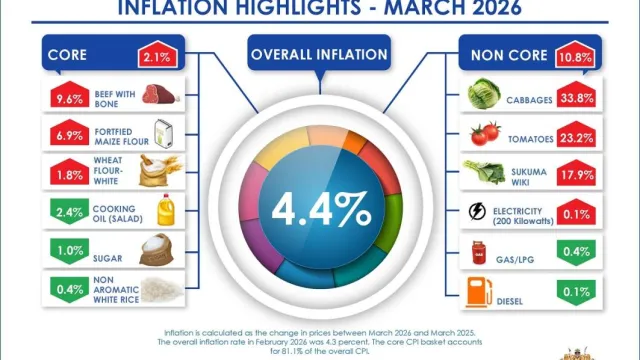
Kenya's year-on-year inflation stood at 4.4 percent in March 2026
Kenya’s annual inflation rose to 4.4 percent in March 2026, driven largely by increases in the cost of food, transport and housing-related expenses, statistics from the Kenya National Bureau of Statistics (KNBS) show.
These three categories, food and non-alcoholic beverages, transport, and housing, water, electricity, gas and other fuels, account for over 57 percent of the Consumer Price Index (CPI), highlighting their outsized impact on household budgets.
Related
Blow to affordable cooking gas push as Kenya drops Sh2.5Bn Aramco deal

“The overall index increased from 149.20 in February 2026 to 150.00 in March 2026, resulting in a monthly inflation rate of 0.5 percent. The year-on-year inflation stood at 4.4 percent in March 2026,” KNBS said in its monthly update.
The CPI measures the weighted change in retail prices paid by consumers for a fixed basket of goods and services over time, using February 2019 as the base period. Inflation reflects the percentage change in this index between two periods.
In March, food prices recorded the steepest increase, with the food and non-alcoholic beverages index rising by 7.7 percent compared to a similar month last year.
Tomatoes led the surge in prices, climbing by 23.2 percent over the year to an average of KSh 99.60 per kilogram from KSh 80.88, and rising a further 13.3 percent between February and March.
The prices of potatoes, a Kenyan stapple, also increased significantly, posting a18.8 percent year-on-year jump to KSh 107.16 per kilogram from KSh 90.22 in March 2025.
Sugar, maize prices ease in March
However, some relief was noted in the past month, with the prices of sugar, maize grain and cabbages easing by 1.3, 2.4 and 3.8 percent respectively. Transport costs rose 3.8 percent over the year, even as fuel prices remained unchanged in March.
“During the period between February 2026 and March 2026, prices of transport-related items showed mixed trends. The price of diesel and petrol remained the same in the review period,” the report noted.
At the same time, KNBS said the housing, water, electricity, gas and other fuels category rose by 2 percent over the year. On a monthly basis, electricity prices increased by 2.5 percent for 50 kilowatt-hour consumption and 2.2 percent for 200 kilowatt-hour, while gas (LPG) prices edged down slightly by 0.1 percent.
Other sectors recorded more moderate increases. The alcoholic beverages, tobacco and narcotics index rose 2.3 percent year-on-year, with beer prices inching up by 0.3 percent in the past month.
The health index recorded annual inflation of 2.7 percent, with cancer medication prices rising by 2.8 percent month-on-month, while general practitioner consultation fees increased marginally by 0.1 percent.
Education costs rose by 3.3 percent over the year, while insurance and financial services registered a modest 0.7 percent increase.
Personal care, social protection and miscellaneous goods and services rose 2.5 percent annually, driven by higher prices of items such as toilet paper, body lotion and slight increases in hairdressing services.
Overall, the March CPI figures underscore the continued pressure on household budgets, as rising costs of essential goods, particularly food, transport and utilities, shape spending patterns and sustain concerns over the cost of living.
Fake pump price poster
Meanwhile, the Energy and Petroleum Regulatory Authority (EPRA) has dismissed claims of an imminent fuel price increases, following the circulation of a fake notice online. In a statement issued on Wednesday, April 1, EPRA clarified that the viral poster purporting to announce new petroleum prices was false and misleading.
The regulator reiterated that, under the Petroleum Act of 2019, it only reviews and announces maximum retail pump prices on the 14th of every month.
“The poster circulating online that EPRA has revised pump prices is fake. Under Section 101 (y) of the Petroleum Act 2019, EPRA announces the applicable fuel price schedule for the subsequent month on the 14th of every month,” EPRA said.
The fake notice had claimed sharp increases, putting Super Petrol at KSh 259.60 per litre, Diesel at KSh 240.80 and Kerosene at KSh 209.40, allegedly due to higher landed costs linked to geopolitical tensions in the Middle East.
The fake notice contradicted EPRA’s last official review on March 14, 2026, which set prices at KSh 178.28 for Super Petrol, KSh 166.54 for Diesel and KSh 152.78 for Kerosene.