Rising debt burden and Iran conflict darken Kenya's 2026 economic outlook
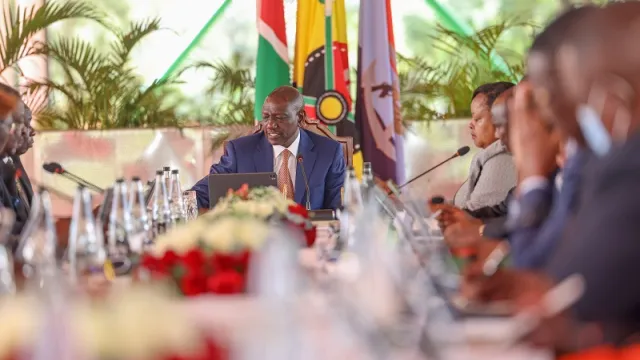
While President William Ruto's government has been projecting a 5 percent economic growth in 2026, the Bretton Woods institution cites geopolitical shocks, warning that they have "intensified inflation and external pressures," in the country, hurting millions of poor households.
Kenya's economy in 2026 is projected to grow the slowest pace since the Covid-19 pandemic at 4.6 percent attributable to a double blow from rising debt burden and the fallout emanating from the worsening war in the Middle East.
According to the latest update from the World Bank, Kenya's 4.6 percent growth is a downgrade of 0.6 percentage points from its forecast before the U.S.-Israel war on Iran broke out in late February.
Related
Counties get Sh428 billion as devolution test looms
Kenya unveils generational fund to escape IV drip of global lenders

"The Middle East conflict intensified external pressures. Leading indicators suggest a sharp monthly decline in exports alongside a significant increase in petroleum import costs," the World Bank notes.
In its July 2026 Kenya Economic Update, the World Bank says East Africa's largest economy is grappling with debt woes, widening fiscal deficits and fast rising levels of poverty.
While President William Ruto's government has been projecting a 5 percent economic growth in 2026, the Bretton Woods institution cites geopolitical shocks, warning that they have "intensified inflation and external pressures," in the country, hurting millions of poor households.
World Bank analysis project that rising public debt is on course to hit 73.5 percent of GDP this year, an uptick from 71.3 percent last year.
With heavy debt obligation, the Washington based lender says interest payments are taking up 35.5 percent of the country's revenue and grants according to disclosures of the Q3 of the just ended fiscal year.
To meet obligations, Dr. Ruto's government has been forced to enhance domestic borrowing, which now accounts for over 56 percent of the country's total debt.
"Longer-maturity securities (up to 30 years) account for the largest share of new domestic financing, and the authorities have chosen to reopen existing bonds rather than introduce new issuances," the World Bank highlights.
However, while domestic borrowing cushions the economy from forex risks, the World Bank warns that it continues to crown out players from the private sector in accessing loans
Currently, the World Bank’s highlights that commercial banks hold an elevated KSh 2.2 trillion in government securities, effectively tying the health of the financial sector to the sovereign’s ability to repay.
Middle East conflict
Additionally, Kenya is facing economic shocks emanating from the ongoing U.S./Israel war in Iran, which has seen pump prices rise sharply hitting transport and production segments of the economy hard.
The retail prices of diesel, a key mover of transport and production, went up by 17.9 percent while petrol increased by 10.8 percent between March and April 2026.
The impact is being felt across the real economy with the World Bank projecting a sharp deterioration in the current account deficit to 4.3 percent of GDP in 2026, driven by a higher import bill and weakened exports.
Furthermore, remittances, which is a vital source of forex for Kenyan households, are under threat, with as much as US$40 million in monthly inflows potentially at risk.
The lender warns that these risks could see Kenya's poverty rate increase by 2 to 4.5 percentage points in 2026, pushing an additional 1 million to 2.4 million Kenyans below the poverty line.
Sectoral Wounds
The slowdown in growth is broad-based, though some sectors are more exposed than others. The services sector, which anchors the economy, is expected to see its growth moderate to 4.9 percent this year from 5 percent in 2025. Within this, the ICT sector, once a bright spot, is projected to decelerate to 5.4 percent from a previous forecast of 6.7 percent as business investment cools.
Further, the manufacturing industry, which grew by a tepid 2 percent last year, is expected to bear the brunt of the energy price shock. The CBK has already downgraded its growth projection for manufacturing to a mere 1.9 percent for 2026. The sector continues to struggle with high production costs and import competition, a vulnerability now cruelly exposed by the oil price shock.
What's more, the World Bank warns that political uncertainty ahead of the August 2027 general election could delay investment and slow reforms, while climate-related shocks remain a persistent threat to the agricultural sector.
"Heightened political tensions could adversely affect business and consumer confidence," the survey states.