Absa Kenya promotes insider Yusuf Omari to CEO position

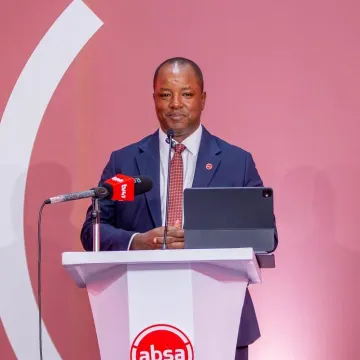
Absa Bank Kenya Managing Director and Chief Executive Office, Yusuf Omari.
Absa Bank Kenya has confirmed Yusuf Omari as its Managing Director and CEO, ending a period of leadership uncertainty at one of the country’s oldest banking franchises and signalling that the lender will prioritise continuity over reinvention as it navigates a lower-interest-rate market that is compressing margins across the sector.
The lender's board announced Omari’s appointment on 10th September, effective immediately, after receiving all required regulatory and internal approvals.
Related
Absa Kenya posts Sh10.5Bn H1 profit, doubles interim dividend
CBK seeks record Sh150bn in re-opened infrastructure bond sale
Until his confirmation, the 57-year-old has been serving as the interim Managing Director and CEO since 1st July, following the departure of Abdi Mohamed, who joined I&M Bank after barely three years in the role.
Omari has spent more than two decades inside the institution formerly known as Barclays Bank Kenya, joining in 2004 from KPMG and rising through internal audit, compliance and most notably, a 17-year tenure as Chief Financial Officer.
He has now held the top job on three separate occasions in an acting capacity, first in 2022 after Jeremy Awori’s departure to Ecobank, again briefly in 2023 before Abdi took over, and now permanently.
“Yusuf’s appointment reflects his proven ability to lead, deliver sustainable growth and create long-term value,” said Chairman Mohammed Nyaoga.
Absa Kenya Performance
Absa Kenya reported a net profit of KSh10.53 billion for the six months to June 2026, a decline of 9.8 percent year-on-year, as falling interest rates compressed yields faster than the bank could reduce funding costs.
Total interest income fell 8.5 percent, even as the loan book rebounded 8.2 percent to a record KSh329.9 billion.
In the past one year, the Central Bank of Kenya has cut rates aggressively, and Absa Group’s own interim results noted that its Africa regions — with Kenya as a key exposure — saw revenue decline 3 percent, contributing to substantially to a 10 per cent drop in regional earnings. Absa Kenya’s return on equity stood at 21.7 per cent in the first half, still strong but down from prior peaks.
Under Omari's interim leadership, Absa Bank Kenya committed KSh100 billion over three years to asset financing across manufacturing, healthcare, education, infrastructure and logistics, with propositions offering up to 100 percent financing for targeted assets.
The bank also launched an 8.9 percent developer-led mortgage product with up to 105 percent financing for qualifying buyers, a strong proposition in a market where mortgage penetration remains low.
“While the dynamic operating environment exerted pressure on performance, the Bank recorded strong momentum in the second quarter,” Omari said in August. “This reflects our disciplined execution, continued support for customers through relevant financial and non-financial solutions, and ongoing investment in the long-term resilience and sustainability of the business”.
As CFO, Omari was credited with improving the bank’s cost-to-income ratio and optimising capital allocation.
Absa Group has been reshaping its branch footprint across Africa, converting full-service branches into sales and service outlets and investing in technology, data and AI capabilities.
Saviour Chibiya, Absa Group’s Regional Executive for East Africa, lauded the appointment as a vote of confidence in a leader who “exemplifies the values of excellence, integrity and performance that define our organisation”.
Kenya’s banking sector - overview
Kenya’s banking sector is crowded and increasingly contested. Equity Group and KCB Group dominate with tens of millions of customers and extensive mobile banking ecosystems.
Standard Chartered and Stanbic retain strong corporate franchises. And new entrants such as Egypt’s Commercial International Bank, Nigeria’s Access Bank and South Africa’s Nedbank, which is acquiring a majority stake in NCBA Group, are all betting on Kenya as a gateway to the East African Community market.
Absa Group itself is increasing its stake in the Kenyan subsidiary to as much as 85 percent through a tender offer, a sign that the Johannesburg-based parent sees Kenya as a core market.
Kenya’s banking industry regulatory environment is also evolving. The CBK has raised the minimum capital requirement from KSh1 billion to KSh10 billion by 2032, a move expected to trigger consolidation.
Absa Kenya’s capital adequacy stood at 19.4 percent in June, well above regulatory minimums, but the long-term trajectory of capital requirements will shape strategic options for all mid-tier lenders.
"My focus will be on building on this foundation, deepening our relationships with customers, accelerating sustainable growth, strengthening our competitiveness and investing in our people and capabilities,” Omari said.