Dangote vows Lamu refinery will be ready in 40 months
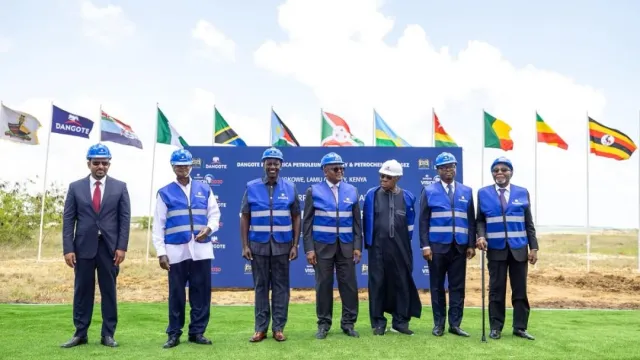
Presidents Kaguta Museveni of Uganda, Wadagni Romuald of Benin and Jean-Lucien Savi de Tové of Togo, and Prime Minister Abiy Ahmed Ali of Ethiopia are in Lamu for the groundbreaking ceremony of the Dangote East Africa Refinery. Former Nigerian President Olusegun Obasanjo and representatives of other African governments are also present.
Aliko Dangote has pledged that the $16 billion East Africa Oil Refinery in Lamu County would be commissioned within 40 months, framing the project as proof that the continent can industrialise at scale without relying on foreign contractors.
Speaking at the groundbreaking ceremony in Mokowe, Lamu County, on Wednesday, Dangote addressed Kenyan President William Ruto, Ethiopian Prime Minister Abiy Ahmed, Ugandan President Yoweri Museveni and other dignitaries. “Lekki refinery in Nigeria proved that it is capable, so Lamu must prove that it can be repeated,” he said.
Related
CBK holds key lending rate at 8.75% as Iran war threatens oil shock
Kenya edges out Tanzania in race for Dangote’s mega oil refinery
“Mr President, and our other respected presidents, my brother, Prime Minister Abiy, I want to assure you will come back here and commission this refinery in 40 months from today.”
The 700,000-barrel-per-day refinery marks Dangote’s largest investment outside Nigeria and is designed to process crude for Kenya and neighbouring markets that currently import almost all refined fuels.
It will also generate 1,000 megawatts of electricity, which is double the capacity of his Lagos plant and produce one million tonnes of polypropylene and base oils.
With mounting protests from locals citing land compensation, Dangote struck an inclusive tone. “We have not come to build in your community, but to build with your community,” Africa's richest man said. “We want the indigenous people to participate in the opportunities created by this investment and there will be many.”
He announced the set up of a training school that would prepare roughly 1,000 Lamu residents, including holders of engineering degrees and diplomas, for jobs at the refinery and related industries. “We are coming here to set up a training school that will train 1,000 of your people,” he told the county governor.
The industrialist presented the refinery as the nucleus of a wider ecosystem rather than a standalone plant. “We are not here merely to build tanks, pipelines, processing units and jetties. We are here to help build an industrial ecosystem,” he said, listing opportunities in energy, petrochemicals, logistics, engineering, marine services, manufacturing and small businesses.
Dangote urged African governments to process more of their resources locally instead of exporting raw materials and importing finished products.
“By 2030, the majority of African countries will be self-sufficient [in fuel]. It does not matter where it is refined, but it should be in the African continent, on the soil of Africa,” he said.
He cited his Nigerian refinery’s role in supplying jet fuel during recent shortages in Europe as evidence that African capacity can serve global markets. The Lamu plant, he added, would aim to capture at least 20 percent of jet-fuel demand in Europe and the United Kingdom.
Dangote also dismissed ongoing local protests over land compensation. In remarks ahead of and during the ceremony he described such challenges as routine, attributing opposition in part to traders whose business models would be disrupted. “There are people who don’t want the development of Africa,” he said. A Malindi court order requiring the status quo on a contested parcel until mid-October did not stop the groundbreaking.
Dangote said the speed of the fertiliser plant he built in Ethiopia and the successful commissioning of the Lekki refinery gave him confidence. Construction equipment has already arrived at Lamu Port and Engineers India Limited has been retained as project manager.
At the moment, Kenya has no commercial crude production at scale and the refinery's supply will initially depend on imports and eventual output from Uganda, South Sudan and Turkana.