EAC central bankers reaffirm 2031 single currency target amid uneven progress
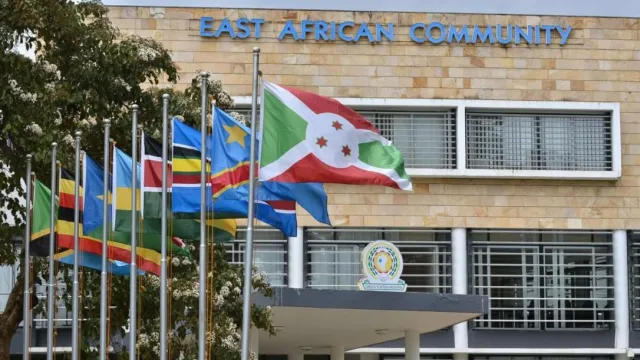
EAC central bankers observe that the monetary union push demands that member countries to meet four key macroeconomic goals including, keeping headline inflation at under eight percent, and maintaining fiscal deficits within three percent of GDP
Top bankers from the East African Community have recommitted to meeting the bloc's goal of establishing a single currency by 2031 despite uneven progress on meeting key criteria.
In a communique following the 29th Ordinary Meeting of the EAC Monetary Affairs Committee in Uganda, Governors of Central Banks recommitted to meeting this goal despite uneven progress and challenges facing the bloc.
Related
Kenya adopts core inflation data to guide monetary policy
Goma flights signal new era of Kenya-DRC trade

The summit, which attracted Central bankers from all eight member countries reaffirmed its resolve to advance the region's monetary union agenda.
"The East African Monetary Union remains a strategic objective that demands sustained commitment, policy harmonisation and strong regional institutions," stated summit chair Dr. Michael Atingi-Ego, Governor of the Bank of Uganda and current head of the EAC Monetary Affairs Committee.
He added: "While our commitment to the Monetary Union is unwavering, we must accelerate implementation, strengthen peer review mechanisms and reinforce national action plans to ensure we remain on course towards a single East African currency by 2031."
The central bankers observed that the monetary union push demands that member countries to meet four key macroeconomic goals including, keeping headline inflation at under eight percent, and maintaining fiscal deficits within three percent of GDP.
Member countries will also be required to contain public debt to 50 percent of their GDP while maintaining forex reserves of at least 4.5 months of import cover.
According to the EAC's FY2026/27 budget however, only four out of the eight member states meet the said inflation ceiling, reflecting an enormous challenge that central bankers must confront.
Additionally, official figures show that only three countries in the EAC have kept fiscal deficit within the prescribed three percent cap while four nations meet the requirements of maintaining the stock of public debt at 50 percent of their GDP.
What's more, only two countries currently meet the reserve-cover requirement, meaning that no single country satisfies all four criteria, a key the prerequisite for joining the monetary union.
The EAC draws membership from Kenya, Uganda, Tanzania, Rwanda, Burundi, South Sudan, the Democratic Republic of Congo and Somalia.
Funding constraints
Beyond economic indicators, the currency project faces deeper geopolitical headwinds. The long-running dispute over which nation should host the East African Monetary Institute, the precursor to a future East African Central Bank, has delayed institutional development.
The EAC allocated just US$4.12 million for the entire regional monetary roadmap in the 2026/27 fiscal year, representing only 3.71 percent of the bloc's total $110.86 million budget.
Despite these obstacles, the EAC has accelerated work on the legal architecture of the monetary union. The East African Legislative Assembly recently passed the EAC Statistics Bureau Bill and the Surveillance, Compliance and Enforcement Commission Bill, both designed to strengthen monitoring of convergence commitments.
Digital integration
The Committee noted that the East African economy continues to demonstrate resilience amid global uncertainties. Regional economic growth is projected at 5.2 percent in 2026, significantly outperforming the Sub-Saharan Africa average of 4.3 percent.
Inflationary pressures have eased, with average headline inflation across the EAC declining to 6.7 percent in FY2025/2026, down from 9.6 percent the previous year.
Further, the committee reviewed implementation of the EAC Cross-Border Payment System Masterplan, which provides a strategic framework for modernising and integrating regional payment systems.
The Masterplan is expected to facilitate seamless cross-border payments, reduce transaction costs, improve interoperability, and boost intra-EAC trade.
"The 7th EAC Development Strategy places renewed emphasis on accelerating the East African Monetary Union agenda by prioritising the completion of legal and technical processes and supporting Partner States in implementing macroeconomic convergence programmes," said EAC Deputy Secretary General in charge of Customs, Trade and Monetary Affairs, Ms. Annette Ssemuwemba.