Ziidi Trader drives 1,241% jump in NSE's retail market activity
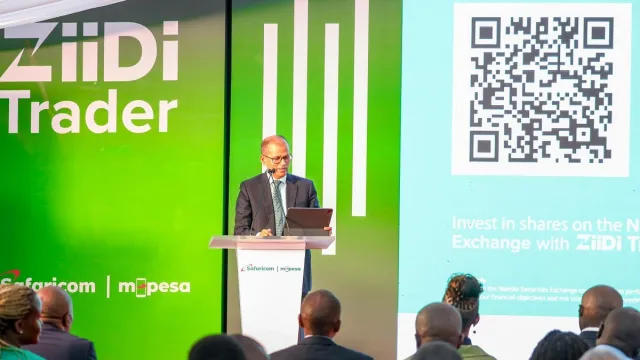
Safaricom PLC CFO Dilip Pal at the launch of Ziidi Trader. The rise in derivatives market activity at the Nairobi Securities coincides with the period when Safaricom PLC unveiled Ziidi Trader in December 2025, opening the window for millions of retail investors in Kenya to buy and sell stocks from the comfort of their smartphones.
The volume of contracts traded in Kenya's derivatives market surged by record 1,241 percent to 78,348 in the three months to March, attributable to the roll out of Ziidi Trader, an investment platform integrated into the M-PESA system.
According to the Capital Markets Authority's latest market report, the Nairobi Securities Exchange (NSE) experienced explosive derivatives activity, reflecting a quiet revolution in the bourse even as foreign investor activity dipped.
Related
Ziidi Trader: a step-by-step guide to trading shares at the NSE
Safaricom's Ziidi gets top honors at 2026 global innovation awards

During the quarter under focus, NSE turnover more than doubled to KSh318 million compared to KSh149 million realised in the previous quarter ended December 2025.
The rise in derivatives market activity coincides with the period when Safaricom PLC unveiled Ziidi Trader in December 2025, opening the window for millions of retail investors in Kenya to buy and sell stocks from the comfort of their smartphones.
"The entry of the Ziidi Money Market Fund and the launch of Ziidi Trader mark a significant milestone in advancing financial inclusion and broadening access to Kenya’s capital markets through digital innovation," explained Capital Markets Authority CEO Wyckliffe Shamiah.
He added: "These market developments are expected to enhance retail investor participation and improve access to investment opportunities via mobile interface and M-PESA.
M-PESA extensive reach
Ziidi Trader has effectively eliminated the barriers for market entry for millions of Kenyans who were otherwise locked out by red tape from stock brokers.
According to Shamiah, Ziidi Trader platform, enhances access to capital markets by leveraging M-PESA’s extensive reach, while also supporting financial inclusion and investor participation.
During the quarter under review, CMA noted that derivatives surge was accompanied by broader equity market strength. For instance, NSE 20 Share Index rose 9.3 percent to 3,432 points, while the broader Nairobi All Share Index gained 4.4 percent. Total market capitalisation expanded by 9.7 percent to close at KSh3.23 trillion.
However, the first quarter of the year experienced a further dip in foreign investor participation, which eased to 32.3 percent, down nearly five percentage points from the previous quarter.
CMA report shows that foreign investors offloaded KSh 22.97 billion worth of equities while purchasing just KSh 14.2 billion, yielding a net outflow of KSh 8.77 billion.
President William Ruto's government provided a reason for hope in the local bourse by listing the Kenya Pipeline Company initial public offering to raise KSh106 billion.
KPC's IPO, which emerged as the largest IPO in the country's history, saw the state offer a 65 percent stake in the government-owned fuel products transporter at KSh9 per share for 11.81 billion shares.
The KPC IPO was oversubscribed by 5.7 percent, and the shares started trading at the NSE on 10th March.
Earlier, the first quarter saw ALP Industrial REIT listed at the Nairobi bourse, marking the first time a USD-denominated security featured in the local market.
The bond market also remained active with the secondary market treasury bond turnover surpassing KSh1 trillion mark in a single quarter for the first time, reaching KSh1.08 trillion, a 49 percent increase year-on-year.
"This increase could be attributed to the issuance of the EABL MTN and Safaricom MTN during the quarter ended December 2025. Notably, the Linzi ABS had the highest outstanding amount at KSh 44.8 billion," the report notes in part.
Official data shows that Central Bank raised KSh 265.7 billion in the primary market through six reopened treasury bonds and two switch bonds.