KCB profit up 10% to Sh18.2Bn as subsidiaries gain ground
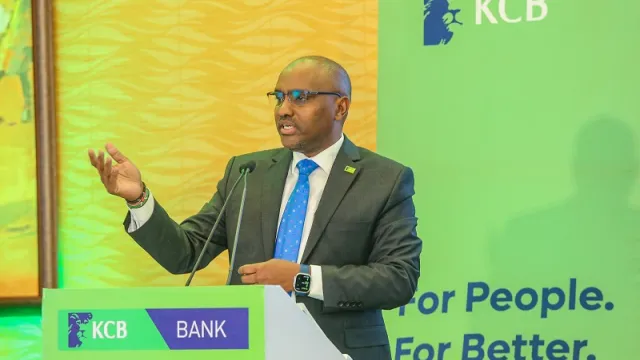
KCB Group CEO Paul Russo
KCB Group PLC has reported a 10 percent rise in net earnings to KSh18.2 billion for the first quarter ending March 31, 2026, driven by a nine percent increase in net interest income and an 8.3 percent jump in non-interest income, even as regional rate cuts squeezed asset yields.
Group’s pre-tax profit for the period stood at KSh24.4 billion, representing a 15.3 percent uptick from the KSh21.2 billion reported a year earlier, underpinned by sustained momentum across its regional banking subsidiaries and non-banking businesses. Total operating income rose 8.5 percent to KSh53.6 billion during the quarter.
Related
NBK sale enhances KCB's competitiveness — Paul Russo
KCB Group assets edge closer to Sh1.5 trillion on acquisition of DRC-based bank

Net interest income climbed to KSh36.6 billion, while non-interest income, which was bolstered by a surge in digital loan disbursements and higher foreign exchange income, reached KSh17 billion.
The group said the growth in non-funded income helped offset the impact of “sustained rate cuts by regulators in the region,” which pushed down asset yields across all its markets.
Balance sheet expands to KSh2.3tn on deposit growth
The group’s balance sheet expanded by 10.8 percent to KSh2.3 trillion, driven by increased customer activity across key business segments.
Customer deposits grew 16 percent to KSh1.7 trillion, supported by sustained onboarding of new-to-bank customers in both corporate and retail businesses.
Gross loans stood at KSh1.32 trillion, up 9.1 percent from KSh1.21 trillion in the same period last year. The group noted that its loan book expansion contributed to interest income growth, even as net interest margin compressed due to the lower-yield environment.
Notably, subsidiaries outside KCB Bank Kenya contributed 29.5 percent of group pre-tax profit and 31.5 percent of the balance sheet, underscoring the success of the group’s regional diversification strategy.
The three non-banking subsidiaries, including KCB Bancassurance Intermediary, KCB Investment Bank, and KCB Asset Management, collectively added KSh547 million in pre-tax profit.
Operating expenses rise
Total operating costs grew by 7.3 percent to KSh24.3 billion with the lender noting that this was due to higher workforce expenses, scaled technology investments and business expansion costs. The increase in costs slightly outpaced operating income growth, putting some pressure on efficiency ratios.
However, the group demonstrated marked improvement in asset quality. The non-performing loan ratio fell to 16.6 percent from 19.3 percent during the comparable quarter in 2025, benefiting from aggressive recovery efforts and the expansion of the gross loan book. The absolute stock of NPLs declined to KSh217.8 billion from KSh233.3 billion.
The group's provisions against potential loan losses were KSh4.9 billion in the quarter, which it said increased both prudential and IFRS coverage ratios.
Geopolitical risks
KCB Group sustained strong capital adequacy ratios, with core capital at 18.2 percent of total risk-weighted assets against a statutory minimum of 10.5 percent and total capital at 21.6 percent against a regulatory minimum of 14.5 percent.
Return on equity improved to 21.5 percent, while earnings per share rose to KSh22.18 from KSh20.03 in the prior year. Total equity attributable to group shareholders grew 18.5 percent to KSh352.2 billion.
The group also disclosed that excluding the impact of NBK, which it divested from in May 2025, year-on-year growth in pre-tax profit and operating income stood at 17 percent and 16 percent respectively.
CEO flags Middle East conflict as key downside risk
Group CEO Paul Russo struck a cautiously optimistic tone. “Despite the challenging operating environment, we delivered solid growth driven by disciplined execution, continued investment in digital innovation, and our unwavering commitment to providing financing which catalyzes economic transformation across the region,” he said.
However, Russo warned of external headwinds. “While economic activity in East Africa remained resilient, we continued to see the impact of the Middle East conflict on economies, with a likely ripple effect of depressed credit demand, increased credit risk and lower remittance receipts, and on deposits.”
Group Chairman Dr. Joseph Kinyua highlighted that the Middle East conflict “presents a significant counterforce to global growth through its impact on commodity markets, inflation expectations and financial conditions.” He added that the group remains confident in its ability to navigate evolving market dynamics.
Green finance and retail push
During the quarter, KCB Bank Kenya secured KSh12.5 billion in financing from the Green Climate Fund and co-financing from the bank to accelerate green projects for micro, small and medium-sized enterprises and farmers.
The lender also introduced a flat fee of KSh20 on Pesalink transfers, with free transfers for amounts below KSh1,000, aimed at making real-time payments more affordable for individuals and MSMEs.