Kenya sets sight on new industrial path with focus on agro-processing
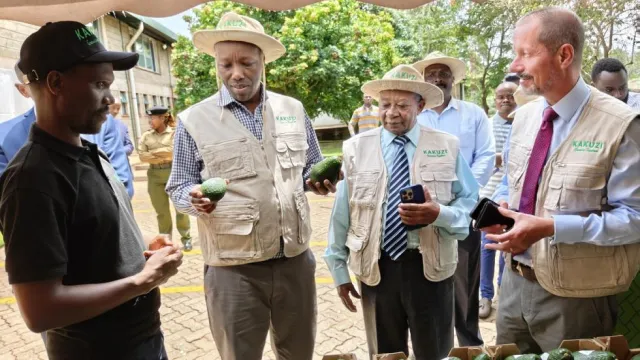
Ministry of Investments, Trade and Industry Cabinet Secretary Lee Kinyanjui (second left) admires avocado fruits at Kakuzi Plc, flanked by the firm's Avocado General Manager Jonathan Kipruto (left), Chairman Nick Ng'ang'a (centre) and Managing Director Chris Flowers (right). This year, Kakuzi plans to double its current export capacity to more than US$100 million per year in the medium term while eyeing an investment of more than US$ 15 million to expand its blueberry-growing venture by increasing its orchards from 10 hectares to 100 hectares.
Kenya plans to the push for value addition and consumption of locally manufactured agro-products as part of the national industrial development strategy, Investments, Trade and Industry Cabinet Secretary Lee Kinyanjui has said.
This strategy will involve the promotion of value addition initiatives, and the enhancement of agro-business capacity targeting various crops and superfoods, including macadamia, avocado, and livestock products.
Related
By going big on super foods, Kakuzi cements base for sturdy growth
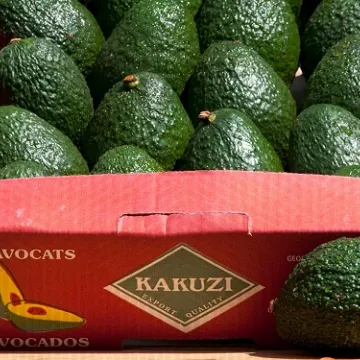
Speaking during a tour of listed agribusiness firm Kakuzi Plc's orchards in Murang’a County, CS Kinyanjui noted that Kenya has the potential to produce edible oils from macadamia, among other oil crops.
The local production of edible oils, he said, will play a key role in advancing import substitution efforts while promoting the Buy Kenya, Build Kenya agenda.
In Kenya, Kakuzi is the largest producer of avocados and the largest single macadamia orchard estate, with plans to double its current export capacity to more than US$100 million per year in the medium term.
This year, Kakuzi is eyeing an investment of over $15 million to expand its blueberry-growing venture by increasing its orchards from 10 hectares to 100 hectares.
While lauding Kakuzi’s value-added capacity, CS Kinyanjui noted that, as global demand for healthy foods grows, Kenya needs to position itself as a major producer of superfoods.
“Demand for food will always be there, even in difficult times such as war. I commend Kakuzi for the great work. As they expand, they also create employment opportunities,” he said.
He added, “The government will continue to support investors in exports. As we open up international markets through economic partnership agreements, we must also ensure we have enough produce to meet demand.”
The country, he acknowledged, spends more than Kes500 billion annually importing agricultural products, including edible oils, which can be grown and produced locally.
The government, he reiterated, is working to shift our economy from dependence on imports to a net exporter of agricultural products, manufactured goods, and value-added commodities.
“I am impressed at the diverse manufacturing and agribusiness value addition that Kakuzi is undertaking, including the daily production of 1,000 litres of cold-pressed Macadamia oil,” Kinyanjui said.
He added, "Working with partners such as Kakuzi and through SEZs, EPZs, and County Aggregation and Industrial Parks, the intention is to transform agricultural produce into high-value products for domestic, regional, and global markets.”
Kakuzi Plc Managing Director Chris Flowers confirmed that the firm is actively undertaking products-and-markets diversification to boost earnings and shareholder value.
Kakuzi's ongoing diversification strategy, he said, prioritises the development of high-quality consumer products for the domestic and export markets.
Kenya, Mr Flowers noted, is ideally placed (geographically) to be Africa’s largest producer of superfoods, supplying the Far-East, the Middle East, Europe and the USA.
“The Kakuzi business growth and diversification plan is firmly anchored in positively contributing to the development and promotion of locally produced, export-grade, quality, value-added products,” Mr Flowers said.
As part of Kakuzi’s industrialisation and the value addition of local oil crops the company has integrated a Macadamia Processing Plant, including a Cold-Press Oil extraction unit.
The Kakuzi Macadamia Processing Plant has an installed capacity of 2,000 tons of saleable kernel (SK), making it one of the largest in Kenya.