Kenya fuels East Africa's rise as the continent's trade hub
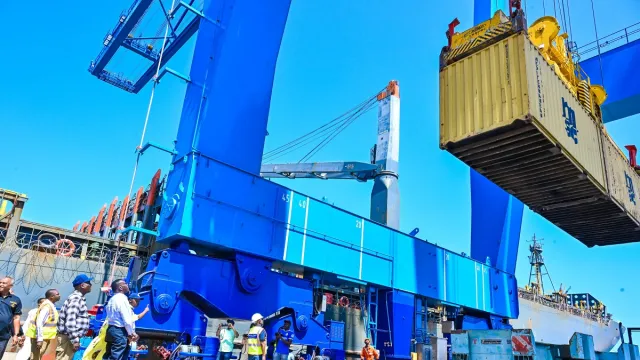
A ship offloading cargo at the Port of Lamu. As part of the Lapsset Corridor Development Authority masterplan, this second deep-sea gateway complements the Port of Mombasa by easing congestion, diversifying trade routes, and opening up Northern Kenya to opportunity. According to the latest Africa Trade Barometer (ATB) by the Standard Bank Group, East Africa has emerged as the strongest-performing zone in Africa, posting a 10 percentage-point jump in export activity.
A wave of key reforms and strategic investments in infrastructure in Kenya has powered East Africa to the forefront of the continent's economic revival, driving both regional integration and exports.
According to the latest Africa Trade Barometer (ATB) by the Standard Bank Group, the region has emerged as the strongest-performing zone in Africa, posting a 10 percentage-point jump in export activity.
Key reforms boosting exports include recent trade reclassification agreement between Nairobi and Kampala, which now treats goods originating in Kenya as intra-regional transfers rather than imports. This strategy has reduced administrative friction within the East African Community, the barometer states.
The fifth edition of the Standard Bank Africa Trade Barometer (ATB) surveyed 2,218 companies, with 71 percent of them being Small and Medium Enterprises (SMEs) drawn from Angola, Ghana, Kenya, Mozambique, Namibia, Nigeria, South Africa, Tanzania, Uganda and Zambia markets.
Cross‑border commerce
“Across the 10 markets we surveyed, firms reported improvements across every major infrastructure category, including power, telecommunications, road, rail, ports and digital border systems," explained Philip Myburgh, Head of Trade for Business and Commercial Banking at Standard Bank Group.
He added: “Together, these 10 markets account for 68 percent of Sub‑Saharan Africa’s GDP, and the shifts highlighted in Issue 5 of ATB point to a more positive outlook for cross‑border commerce on the continent.”
The report singles out Kenya and Tanzania’s renewed commitments to remove non-tariff barriers as key reforms that are increasingly powering cross-border business while improving trade coordination.
Combined with major corridor upgrades across the Northern and Central transport routes, these trade reforms are reducing border delays, improving logistics predictability and strengthening supply-chain reliability, Standard Bank Group survey states.
"For businesses operating in the region, this is translating into lower transaction costs and greater confidence in scaling cross-border operations," the barometer shows.
Taken together, the ATB suggests East Africa’s export momentum reflects a shift from policy intent toward operational trade integration across the region.
U.S. trade tariffs shift Africa export business to China
East Africa's emergence as the strongest-performing subregion across the continent comes at a time of shifting global trade policy, including tariff changes affecting access to the United States market.
According to the Barometer, economies across Africa are experiencing a decline in trade with U.S. trade partners attributable to President Donald Trump's tariffs and uncertainty around the African Growth and Opportunity Act (AGOA) future.
To counter U.S. tariffs hit, surveyed firms report increasing engagement with Asian markets, particularly China, citing competitive pricing, product variety, faster response times and supply-chain reliability as key drivers of sourcing decisions.
African markets are experiencing improvement in trade-enabling infrastructure even as investor confidence and macroeconomic stability strengthens.
On average, economic growth across ATB markets is trending towards 4.3 percent in 2026, supported by moderating inflation in seven of the 10 economies and improvements in external debt positions.
The business confidence index rose to 65, with most companies surveyed expecting stronger turnover and more stable trading conditions. Commodity strength, particularly in gold, platinum and copper, has provided a further uplift for exporters and foreign exchange earners.
AfCFTA awareness climbs to 50%
Further, awareness about the gains of the African Continental Free Trade Area (AfCFTA) has increased to 50 percent, with firms citing easier movement of goods, wider market access and industrialisation benefits.
Africa’s trade outlook is being reshaped by integration, improved infrastructure, firmer macro fundamentals and rising business confidence. At the same time, geopolitical developments, including the ongoing conflict in the Middle East, introduce uncertainty around energy prices and supply-chains that could affect trade costs in the near-term.
“As AfCFTA implementation deepens, and as more countries harmonise customs, regulatory frameworks and logistics platforms, Africa’s ability to expand industrial capacity, scale regional value-chains and strengthen competitiveness is set to accelerate”, concludes Myburgh.