How M-PESA’s Fintech 2.0 era is rewriting Kenya’s financial inclusion story
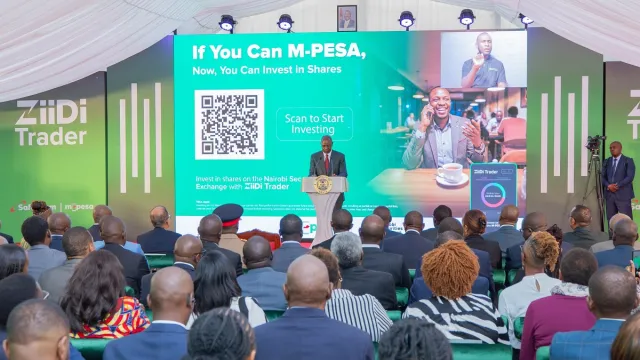
Under the Fintech 2.0 framework, M-PESA has systematically expanded into wealth management, credit, and investment products like Ziidi Money Market Fund, stock trading capabilities through Ziidi Trader that were once the exclusive domain of Kenya’s brick-and-mortar banking industry.
When M-PESA launched on March 6, 2007, it solved a simple problem: sending money across Kenya without handing cash to a bus driver. Nineteen years later, that solution has evolved into a comprehensive financial ecosystem used by 40 million monthly active customers for transacting, saving, investing, and building wealth.
The milestone, announced as the platform marked its nineteenth birthday, represents more than a numerical feat. It signals a fundamental shift in how Kenyans interact with money, which Safaricom’s leadership calls “Fintech 2.0,” a shift from just a mobile money utility to an embedded financial ecosystem.
Related
Ziidi Trader makes buying shares as easy as sending M-Pesa
Safaricom's Ziidi gets top honors at 2026 global innovation awards

“Our goal is to give Kenyans, and Africa at large, digital financial tools to empower them to be more prosperous,” said Peter Ndegwa, Safaricom’s Group CEO, in a statement marking the 40-million customer milestone. “To us, every M-PESA transaction tells a story of someone building their future”.
M-PESA’s Fintech 2.0 blueprint
For the first decade of its existence, M-PESA’s value proposition was simple: send money, pay bills, store value safely. The second decade has been defined by something far more complex: the transformation of a telecom-led payments service into a diversified financial services platform capable of challenging traditional banks on their own turf.
Under the Fintech 2.0 framework, M-PESA has systematically expanded into wealth management, credit, and investment products that were once the exclusive domain of Kenya’s brick-and-mortar banking industry.
The platform now offers investment vehicles such as Ziidi Money Market Fund, stock trading capabilities through Ziidi Trader, credit products such as Fuliza and KCB M-PESA, and a suite of business solutions including Lipa na M-PESA, Pochi la Biashara, and Global Pay.
In the first half of financial year 2026, M-PESA revenue increased by 14 percent year-on-year to KES 88.06 billion, accounting for 45.4 percent of Safaricom’s total service revenue. At the same time, transaction volumes went up by 26.5 percent to 21.87 billion, while transaction value rose by 5 percent to KES 20.21 trillion.
Ziidi MMF and Ziidi Trader pitched to build wealth
Perhaps one of the most outstanding features of M-PESA’s Fintech 2.0 era is the Ziidi suite of investment products, bespoke offerings that are designed to move Kenyans from simply keeping money to actively growing wealth.
Launched in December 2024 in partnership with Standard Investment Bank and ALA Capital Limited, the Ziidi Money Market Fund lowered the barrier to entry for investing to just Ksh100, allowing customers to earn daily interest on their savings while maintaining instant access to their funds through M-PESA wallets.
By June last year, just six months after launch, the fund had already accumulated KES 10.68 billion in assets under management, generating KES 354.36 million in investment income during its first half-year of operation.
Building on that success, Safaricom launched Ziidi Trader in February 2026, a partnership with the Nairobi Securities Exchange (NSE) that enables M-PESA users to buy and sell shares listed on the bourse directly from their mobile devices. Ziidi Trader allows users to track portfolios, monitor dividends, set price alerts, and maintain target stocks’ watchlists, all without leaving the M-PESA ecosystem.
“Our partnership with Safaricom brings the stock market closer to the daily lives of Kenyans,” said Frank Mwiti, Chief Executive of the NSE, at the launch.
He added: “By making NSE transactions accessible through M-PESA, we are broadening participation in investment, both locally and internationally, and enabling more people to play an active role in Kenya’s economic growth”.
Transforming access to credit
Fintech 2.0 has also transformed how Kenyans access credit. Today, M-PESA customers can choose between three primary credit products: Fuliza, M-Shwari, and KCB M-PESA, each designed for different use cases and repayment horizons.
Fuliza, the overdraft facility that automatically covers transaction shortfalls, remains popular in the short-term credit space, serving over 33.4 million users and disbursing Ksh629 billion in the first half of FY2026.
Fuliza’s appeal lies in its seamlessness, no application process, no waiting for approval. But that convenience comes at a cost. On its part, M-Shwari, the longer-standing credit product offered in partnership with NCBA Group, serves customers with larger borrowing needs. At the same time, KCB M-Pesa has emerged as another option, offering borrowers flexible repayment terms between one and 12 months.
Artificial Intelligence (AI) Integration
The evolution of M-PESA’s product suite has been matched by a fundamental overhaul of its underlying technology, a transformation that Safaricom’s techies describe as the most significant in the platform’s history.
In September 2025, Safaricom executed a complex migration of 35 million M-PESA users from a monolithic legacy system to a cloud-native microservices architecture, a transition that required the coordinated effort of 210 Kenyan developers, 100 on-site partner developers, and 300 remote developers worldwide.
The new architecture, built on active-active redundancy across multiple hosting sites, ensures that a failure in one component no longer affects the entire system, a departure from the previous model where a single database outage could impact all 35 million users.
“The system that we have today, for example, has one single database… if that database goes down, it impacts all customers,” explained Felix Rop, Safaricom’s Head of Financial Services IT, before the migration. “With the upgraded platform, the database would be split into sections, called stripe units… it will be possible for the rest to continue as the problem is fixed”.
The upgrade is paying dividends with transaction capacity increasing from 4,500 to 6,000 transactions per second and allowing scalability to 12,000 during peak periods. According to Safaricom, the platform now maintains round-the-clock availability while processing over 100 million transactions daily.
What’s more, in November 2025, Safaricom launched Daraja 3.0, an updated developer gateway for Fintech 2.0, which enables third-party developers to build “Mini Apps” that run within M-PESA Super App. For businesses, this means instant access to Safaricom’s 40-million customer base without requiring users to download separate applications.
“Daraja 3.0 is a gateway to the next frontier of fintech,” said Esther Waititu, Safaricom’s Chief Financial Services Officer. “By empowering developers with secure, scalable, and intuitive tools, we are unlocking new possibilities in digital finance”.
AI-powered fraud prevention
As M-PESA has grown into a financial ecosystem spanning investments, credit, and commerce, the need to safeguard customer data and money has intensified. Safaricom has responded with substantial investments in artificial intelligence-driven security systems that represent a significant upgrade from traditional rule-based fraud detection.
In June 2025, Safaricom partnered with Amazon Web Services (AWS) to introduce graph neural networks capable of analyzing relationships between users and transactions to identify potential fraud with a high degree of accuracy. The system operates in real-time, flagging suspect patterns before transactions are completed rather than after losses have occurred.
“By integrating AI-driven capabilities into our core business systems, we are not only enhancing operational efficiency but also enabling faster, more agile product launches,” explained James Maitai, Safaricom’s Chief Technology Information Officer.
The telco has committed $500 million (about KES 65 billion) over three years to build AI-ready infrastructure across East Africa, including NBOX1 Nairobi Campus data center with 22.5 megawatts of capacity, which will be the largest facility of its kind in East Africa.
This infrastructure supports not only Safaricom’s operations but also those of local startups, government agencies, and enterprises that require AI capabilities without the resources to build their own data centers.
Inclusion, Innovation, and Scale
As M-PESA edges closer to its 20th year, the contours of its next phase are coming into focus. The platform now serves 40 million monthly active customers in Kenya, with a total customer base of 62.27 million across its operations.
In new frontier Ethiopia, where Safaricom launched M-PESA services in 2023, the platform has attracted over 11.2 million active customers, offering a glimpse of the regional expansion potential that analysts believe could help drive future growth.
“Reaching 40 million monthly active customers in Kenya is a milestone we celebrate, as we recommit to enabling every Kenyan to transact safely, grow their savings, and build their wealth,” Safaricom CEO, Dr. Ndegwa, stated.
For the millions of Kenyans who have moved from simply sending money to investing in money market funds, trading stocks, and accessing credit through their mobile phones, the transformation is already complete.
However, for millions more who have yet to fully engage with these tools, Fintech 2.0 represents an invitation, one that Safaricom’s leadership believes will define the next chapter of Kenya’s financial inclusion story.
“M-PESA remains committed to ensuring that everyone has the confidence and tools to navigate life’s financial journey,” Ndegwa noted.