Mbadi rules out new taxes but bets big on domestic borrowing
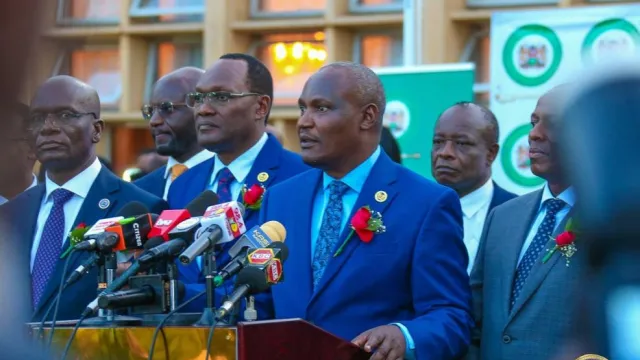
National Treasury Cabinet Secretary John Mbadi flanked by Treasury and MPs addressing the media on the FY2026/2027 budget.
With the ghosts of June 25th 2024 Gen-Z fury against President William Ruto's government looming large, National Treasury CS John Mbadi rules out any new taxes to finance Kenya's KSh4.82 trilion budget amid economic hardships that have left taxpayers with little take-home.
In his lengthy speech made on Thursday, Mbadi opted to finance the FY2026/27 budget deficit totalling KSh1.146 trillion through a blend of loans, broadening of already frayed tax base, push on fiscal reforms and excise adjustments.
Related
Schools shut, economy bleeds as revolt against high fuel prices grips Kenya
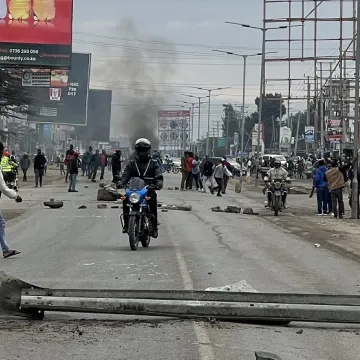
Bankers push CBK to raise key rate as oil shock sparks inflation fears
With a fiscal deficit estimated at 5.5 percent of the GDP, Mbadi said the Treasury is projecting to secure up to Ksh116.2 billion in external debt and KSh1.03 trillion in domestic borrowing to plug the budget deficit.
“I have deliberately chosen not to introduce new taxes or increase tax rates that would further overburden the hardworking Kenyans and their families,” Mbadi stated.
“Instead, the [tax] measures are focused on reforms that improve efficiency in tax collection, create fairness in the tax system, and broaden the revenue base without burdening the mwananchi (ordinary citizen).”
In the spending plan ending June 30 2027, President William Ruto's govenment forecasts to collect Ksh3.63 trillion in revenue, representing 17.4 percent of the country's GDP, with the taxman expected to record KSh2.985 trillion in ordinary revenue.
Mbadi's proposed tax package is expected to yield an additional KSh98.9 billion for the government, largely through enhanced tax compliance measures rather than increases in taxes.
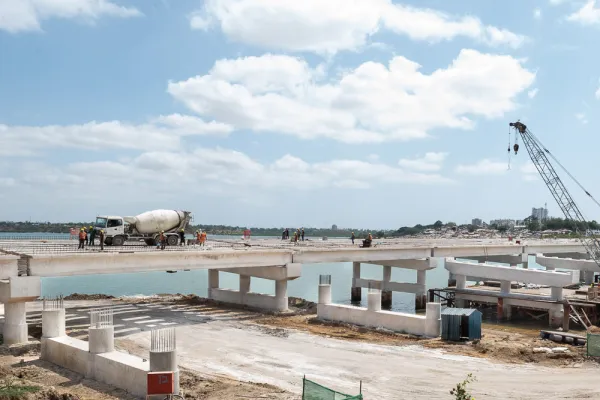
In his speech, the CS struck a notably sober tone on Kenya’s infrastructure financing gap, which he said stands at approximately $5 billion annually.
He noted that “the era of financing every road, every power line, and every dam through government borrowing and taxation is over,” citing unsustainable debt service obligations that crowd out spending on health, education, and social protection.
Dr. Ruto's medium-term fiscal consolidation strategy targets an ambitious cut in the fiscal deficit, including grants, from 5.5 percent of GDP in 2026/27 to 3.3 percent by 2028/29.
However, official data shows that the 2025/26 supplementary budget already saw the deficit widen to 6.4 percent of GDP, up from an original 4.7 percent, attributable to slower-than-expected tax receipts and pressure from collective bargaining agreements and emergency drought and flood responses.
At the moment, Kenya's macroeconomic conditions remain fragile. The overall inflation rose to 6.7 percent in May 2026, up from 3.8 percent a year earlier, driven by surging global oil prices linked to the ongoing Middle East conflict.
The price of crude in the international oil markets climbed from an average of $63.06 per barrel in February 2026 to $94.4 per barrel by the end of May. In order to cushion customers from the negative impact of sky-high pump prices, the government temporarily lowered VAT on petroleum products from 16 percent to 8 percent for three months and deployed billions of shillings from the Petroleum Development Levy Fund to subsidise pump prices.
The cost of fuel remains high, pushing up the cost of goods, and worsening the business climate.
No new taxes, but plenty of changes
While ruling out headline tax increases, the Treasury CS unveiled a suite of technical and targeted adjustments to sustain government fucntions amid global turmoil in the next 12 months.
Key among them is a sharp reduction in the corporate tax rate for non-resident petroleum contractors to 30 percent from 37.5 percent currently, a move that Mbadi said helps harmonise the charge with the rate applicable to other non-resident enterprises.
The budget also introduces a minimum deemed dividend distribution threshold of 60 percent of undistributed income, a package that seems targeted at companies that indefinitely retain their annual earnings to defer the taxation of dividends.
“When companies make profits, those profits should find their way back to shareholders within a reasonable time,” Mbadi cautioned.
Other tax measures for the FY2026/27 include:
- A fresh withholding tax on gambling winnings, lotteries and prize competitions;
- A 1.5 percent withholding tax on scrap metal sales to improve traceability;
- Removal of an exemption that allowed the national carrier to pay non-resident service providers without withholding tax, while resident providers are taxed;
- A general anti-avoidance rule across all tax laws to prevent arrangements designed primarily to obtain tax benefits.
Mobile phones, bottled water and sugar-sweetened beverages
In a move aimed at enhancing digital inclusion in East Africa's crown jewel, Mbadi proposed simplifying mobile phone taxation by replacing multiple existing levies with a single 25 percent excise duty payable at the point of network activation.
This means that mobile phones will also be exempt from VAT, Import Declaration Fee, and Railway Development Levy starting July 1st.
Additionally, excise duty on bottled water, which is currently Sh6.41 per litre, will be removed entirely. “It is expected that vendors of bottled water will pass this benefit to ordinary citizens by lowering the price,” Mbadi said.
Conversely, excise duty on sugar-sweetened beverages will increase to Sh20 per litre from Sh14.14 per litre as part of bold push to counter health risks associated with the excessive consumption of sugar.
Smokers will however have to dig deeper in their pockets with Mbadi proposing that tobacco duties will increase, with manufactured tobacco products rising to Sh12,550 per kg from Sh11,382.48 per kg while cigars will jump to Sh18,000 per kg from current Sh16,260.29 per kilo.
Tax amnesty
Treasury CS noted that Kenya’s tax expenditure, which refers to the foregone revenue through exemptions and incentives, stood at KSh286.5 billion in 2024, equivalent to 1.8 percent of GDP, down from 2.4 percent in 2023.
For the FY2026/27, the budget proposes to rationalise further by removing VAT exemptions on denatured ethanol, direction-finding compasses, affordable housing construction inputs, tourism facility inputs, and certain aircraft, while also limiting zero-rating primarily to exports.
What's more, in a strategy to help clear legacy tax liabilities by individuals and businesses, the government is offering a six-month tax amnesty starting July 1, 2026, covering penalties, interest, and fines on tax liabilities accrued up to December 31, 2025. A previous amnesty covered liabilities up to December 2023.
Despite his measured tone, Mbadi did not disguise the depth of Kenya’s fiscal woes. Only 3.1 million working Kenyans currently contribute to Pay As You Earn (PAYE), he noted, while millions who earn income file nil returns year after year. “The burden of developing this country has therefore been on a few of us. This must change,” he said.
The government has also extended the deadline for commercial banks to raise minimum core capital from Sh1 billion to Sh10 billion, pushing the target to December 2032 from December 2029 to steer clear of disruptive credit contraction, particularly for thousands of MSMEs.
With global uncertainty from the Middle East conflict showing no signs of abating in the wake of fresh U.S.-Israel strikes on Iran, and Kenya still working to exit the FATF grey list, Mbadi’s budget walks a narrow line between fiscal consolidation and political survivability, exactly one year after the deadly June 25th 2024 protests that forced the withdrawal of previous tax hikes.
“The message from Kenyans across the country, from our rural villages to our bustling towns, is clear and consistent,” Mbadi said. “They want to see a government that listens.”