Kenya secures Sh162bn World Bank funding for key projects
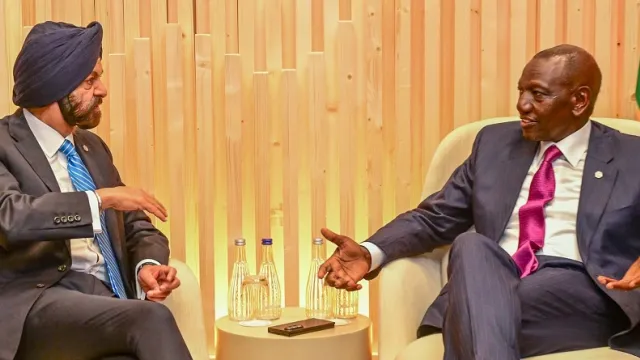
President William Ruto with World Bank Group President Ajay Banga on the sidelines of the G7 Summit in Évian, France.
Kenya has secured a $1.25 billion (about KSh162 billion) financing package from the World Bank, bolstering President William Ruto’s reform push just two weeks after his meeting with the lender’s president, Ajay Banga during the G7 summit in France.
In an update dated 29th June, the cumulative financing comprises of $750 million (about KSh97.13 billion) in Development Policy Operation (DPO) and $500 million or KSh64.755 billion in Sustainability Linked Loan.
Related
Counties get Sh428 billion as devolution test looms
CBK's bond market goes global with Clearstream-Kenya connection
The DPO, which is the seventh such operation since 2018 for Kenya, is structured as a $340 million loan from the International Bank for Reconstruction and Development (IBRD) and $410 million in concessional financing from the International Development Association (IDA), including dedicated livelihoods support for refugees and host communities.
Latest financing comes as Kenya’s public finances remain under pressure from heavy debt and wide fiscal deficits, with the economy projected to grow 4.3 percent this year.
Preventing corruption
According to the World Bank, the operation supports a country-led reform programme to make public resources more transparent, efficient and equitable, with a central focus on strengthening governance and preventing corruption.
Kenya has enacted a Conflict-of-Interest law and gazetted the Conflict-of-Interest Regulations 2026, which set clear rules to prevent, detect and investigate situations where public officials could use their positions for private gain.
The regulations introduce stronger penalties and improved disclosure requirements, closing loopholes that have historically allowed conflicts of interest to go unaddressed.
The government has also directed all Ministries, Departments, and Agencies to use the Treasury Single Account, reducing idle cash in fragmented accounts and giving the Treasury a clearer view of government cash balances. This programme further advances electronic government procurement to make public contracting more open, competitive and transparent.
“By supporting reforms to address conflicts of interest, strengthen procurement systems, improve public financial management and expand social protection, this operation will help Kenya reduce leakage, generate fiscal savings, and ensure that public resources deliver better results and reach the people who need them most,” explained Qimiao Fan, World Bank Division Director for Kenya.
Innovative sustainability-linked financing
The additional $500 million Sustainability Linked Loan marks a significant innovation in Kenya’s borrowing strategy. Unlike green bonds that restrict how proceeds are spent, this facility ties the cost of borrowing to measurable environmental and social outcomes.
The loan is linked to two key performance indicators: reducing deforestation and expanding rural electricity access. Meeting targets lowers the interest rate; missing them increases borrowing costs.
The deforestation target aims to limit cumulative loss of natural forests from a 2024 baseline to below 44,000 hectares by 2030, with a stretch target of 38,000 hectares. Without new policy action, deforestation is projected to reach nearly 50,000 hectares by the end of the decade.
The electricity target seeks to raise rural access from 67.9 percent in 2023 to 81.8 percent by 2030. Meeting the target would leave borrowing costs unchanged, while surpassing it to reach 94.4 percent would reduce the coupon.
Japanese credit market
The World Bank package comes just nine days after Kenya secured ¥25 billion ($22 million or KSh2.85 billion) through a Samurai Loan from Japan, marking the country’s first foray into the Japanese credit market.
The Samurai facility, carrying interest rates of between 0.5 percent and 3 percent, is earmarked for Kenya’s automotive policy, energy loss reduction and broader reform and development agenda.
Proceeds from the Sustainability Linked Loan are specifically earmarked for retiring expensive existing debt and providing budget support, offering Kenya a cheaper alternative to commercial borrowing.
World Bank's financing comes as Kenya continues negotiations with the International Monetary Fund for a new programme to replace the $3.6 billion facility that collapsed in March 2025.