Kagwe's ‘farm to port’ blueprint aims to unlock Coast region's farming potential

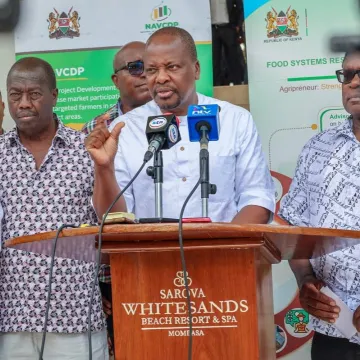
Agriculture and Livestock Development Cabinet Secretary Mutahi Kagwe at the 2026 ASK Mombasa International Show.
The Ministry of Agriculture has launched an ambitious economic strategy targeting the Coast region with a mission to quadruple the production of key cash crops and livestock products.
Agriculture and Livestock Development Cabinet Secretary Mutahi Kagwe announced the Coast Region Economic Revival Strategy at the ongoing ASK Mombasa International Show, outlining a “From Farm to Port” approach designed to transform the region’s agricultural economy.
Related
Drought pushes Kenya to import 25M bags of maize to seal food deficit
Kenya edges out Tanzania in race for Dangote’s mega oil refinery
The plan will see Lamu, Tana River, Kwale, Kilifi and Taita Taveta counties increase the production of key commodities in the region including cashew nuts, coconut, cassava, cotton, milk and meat.
“These counties have the potential to triple and even quadruple production of such products,” Kagwe said, adding: “Our interest is to bring technology to agriculture. The public and private sector need to work together”.
Kagwe's strategy assigns complementary roles to different counties. While Kwale, Kilifi, Taita Taveta and Tana River will focus on primary agricultural production and local value addition, Mombasa and Lamu will offer supply chain and logistics infrastructure linking producers to markets across Kenya, East Africa.
Cotton farming revival
Cotton production has already shown significant growth, with the area under cultivation expanding from 8,000 hectares in 2022 to approximately 18,000 hectares. As a result, cotton production has risen to 15,000 bales from 6,779 bales over the same period.
To drive up output, the ministry is supporting the subsector through the introduction of Bt cotton and enhanced coordination across the value chain.
Cotton farming has been bolstered by two modern ginneries in Kwale and Lamu, which provide farmers with a ready market and eliminate costly transportation to distant facilities in Makueni, Kitui and Meru.
Thika Cloth Mills, which operates the Lamu ginnery, has raised farm-gate prices from Sh52 to Sh72 per kilo following a presidential directive.
“This is just the beginning of a cotton revolution in the Coast,” said Asthman Mwadime, a Kwale farmer. “We can now farm cotton with confidence, knowing we have a ready buyer and that it will put food on our tables”.
Coconut value chain
The coconut subsector, which is supporting over 100,000 farming households along the Coast, has been identified as a strategic priority. Official statistics show that over 100,000 tonnes of coconut valued at approximately Sh10.8 billion were processed in 2025.
Additionally, CS Kagwe said the government is facilitating modernisation and industrialisation of the coconut value chain to move beyond raw production towards higher-value products including virgin coconut oil, coconut water, coconut flour, cream and milk.
The sector currently contributes an estimated 1.5 per cent to agricultural GDP and 0.4 per cent of Kenya’s total GDP.
The Kenya Plant Health Inspectorate Service has introduced a new high-yielding hybrid coconut variety that matures in three years, compared with five to seven years for conventional varieties, producing 250-300 nuts annually against 100 for the tall variety.
Kentaste Products, a major coconut processor in Kwale, has expanded from sourcing 5,000 coconuts daily to nearly 1.5 million per month and employs nearly 300 full-time workers while supporting more than 50,000 livelihoods indirectly.
Agricultural digitalisation
The CS noted that the region’s transformation depends on technology and innovation, with the Kenya Agricultural and Digital Information Centre positioned as a one-stop centre for agricultural digitalisation.
Additionally, partnerships are expected to accelerate adoption of mechanisation, drone technology, animal identification and traceability, artificial intelligence and other digital solutions.
The bold plan will also see the ports of Mombasa and Lamu serve as critical gateways to the market, with road and rail infrastructure linking producers to processing and export points.
CS Kagwe noted that maize produced in the region will be stored at the National Cereals and Produce Board depot in Voi to reduce post-harvest losses.
The government is also reviewing support for the cashew nut subsector through subsidised seedlings, expansion of acreage and value addition.
A Swiss investor is establishing a multimillion-dollar facility at the Dongo Kundu Special Economic Zone to produce novel tea extracts, while the Galana Kulalu commercialisation initiative has attracted at least Sh9 billion in investment.
Kagwe acknowledged that agriculture is a devolved function, making county governments central to the transformation. He challenged coastal counties to work with the national government on issues including erratic rainfall, high input costs and poor infrastructure.