Drought pushes Kenya to import 25M bags of maize to seal food deficit
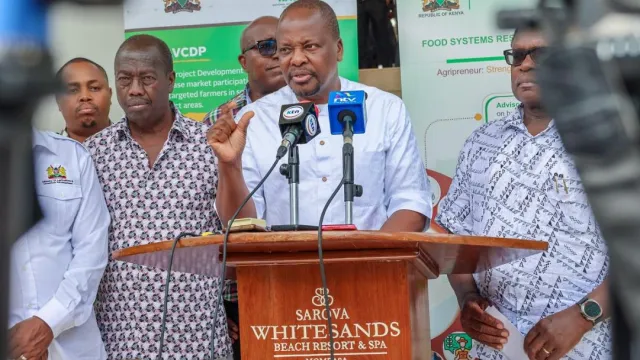
Agriculture Cabinet Secretary Mutahi Kagwe.
Kenya plans to import upto 25 million 90-kg bags of maize to seal expected food shortage due to drought that has affected grain production in parts of the country.
In an update made on Wednesday, Agriculture CS Mutahi Kagwe said the move is part of the latest measures to guarantee food security in the country which consumes 75 million bags of maize every year.
Related
Win for farmers as Kenya halts sugar imports beyond Comesa, EAC

The country is projecting reduced harvests in several food-producing regions, occasioning a shortfall of nearly 25 million bags.
"We will import maize. We have already made arrangements for that. We will manage the country. The country is not going to go hungry," said Kagwe.
The CS noted that while maize imports will provide an immediate solution to the projected shortage even as his ministry rolls out interventions aimed at strengthening local food production and reducing the country's vulnerability to climate change.
Among the key interventions is the expansion of irrigation projects such as the Galana Kulalu scheme, which is expected to boost agricultural productivity, increase resilience against drought and reduce dependence on rain-fed farming.
He said the Government will also collaborate with the National Treasury to streamline taxes and address bureaucratic challenges affecting farmers and agribusinesses in an effort to make the agricultural sector more competitive and profitable.
At the same time, youth employment emerged as a key priority during the Fifth Joint Consultative Meeting of County Executive Committee Members (CECMs), where the Ministry officially launched consultations for the upcoming AgriConnect Compact Programme.
CS Kagwe said thousands of jobs could be created through the programme as the Government seeks to transform agriculture from a subsistence activity into a modern, technology-driven and commercially viable sector.
The meeting, which brought together leaders from the national government, county governments and the World Bank Group, reviewed the progress achieved under the Food Systems Resilience Program (FSRP) and the National Agricultural Value Chain Development Project (NAVCDP), both of which will transition into the AgriConnect Compact Programme.
According to the CS, the programme will be anchored on three key pillars: increasing agricultural productivity, promoting value addition and creating sustainable employment opportunities through agribusiness.
He emphasized that agriculture should no longer be viewed as a last resort for survival, but rather as an engine for wealth creation, investment and job generation, particularly like for young people.
The programme will also champion the digitization of agriculture, the adoption of artificial intelligence and the integration of modern farming technologies to improve productivity and make the sector more attractive to the next generation.