What it takes to finance East Africa’s multi-billion dollar energy transition
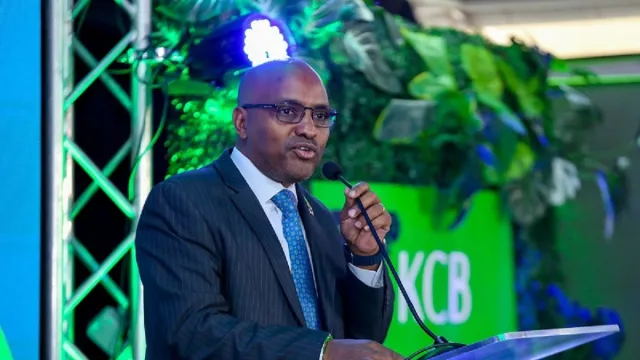
KCB Group CEO Paul Russo. In the last financial year, KCB Group’s credit to the energy and water sector across the six African countries it operates stood at Sh47.3 billion, a 48 per cent increase compared to a similar period in 2024.
Next month hundreds of energy ministers, industry leaders and investors will meet at the Cape Town International Convention Center for African Energy Week.
The meeting is meant to unite stakeholders across upstream, midstream, downstream, renewable and services to discuss the continent’s energy needs, explore investment opportunities and partnerships.
Related
Green energy transition for a healthier planet

Kenya steps up switch to green energy
This comes at a time when most African countries are seeking to expand their energy infrastructure and decarbonise, while also exploring their financing options for these capital-intensive and long term projects.
A recent report by the Africa-EU Energy Partnership (AEEP) for instance found that, while total commitments from the EU dedicated at achieving SDG-7 on the continent hit EUR20.6 billion (Kshs3 trillion) between 2014 and 2023, resources remain inadequate to meet the projected needs of the continent’s energy demands.
This includes electricity access where half of the continent has been left out, access to clean cooking fuels and technologies which stood at 21 percent in Sub-Saharan Africa in 2023 and new renewable energy capacity.
According to the International Energy Agency, IEA, electrification in Africa has barely kept pace with population growth and progress in widening access in recent years has stalled compared to pre-pandemic levels. For instance less than 19 million people gained access in both 2023 and 2024, compared to 23 million people in 2019.
“Nearly USD$150 billion in cumulative investment – USD$15 billion per year – is required to reach universal electricity access by 2035,” explains the IEA.
“Just under half of this investment (USD$7 billion annually) targets the expansion of grid networks, with around a third (USD$5 billion annually) going to mini-grids and just over 20% (USD$3 billion annually) to solar home systems,” explains the global energy agency in its latest special report on energy financing needs in Africa.
East Africa’s largest economy Kenya has estimated that it would need up to USD$600 billion in capital investment over the next 25 years to achieve Net Zero carbon emissions across all key sectors that use energy.
Under the Kenya Energy Transition and Investment Plan, the government anticipates capital markets to provide the largest funding pools. The investment will go into electric mobility projects, clean cooking initiatives and low carbon hydrogen and is expected to support an additional 500,000 net new jobs by 2050 and beyond.
This financing need is massive and calls for a combination of national government spending, private finance and equity capital, all of which have in recent years funnelled hundreds of millions of dollars into the continent’s energy networks.
In the East African region, commercial banks such as KCB Group that have a regional footprint are demonstrating how financiers can move beyond conventional lending into complex, long-term energy financing for upstream oil, regional crude infrastructure, gas and power projects.
In the last financial year for instance, KCB Group’s credit to the energy and water sector across the six African countries it operates stood at Sh47.3 billion, a 48 per cent increase compared to a similar period in 2024.
In March this year KCB Bank Kenya received approval for a Shs12.5 billion project to be co-financed by the Green Climate Fund (GCF). The blended finance initiative, a mix of concessional lending, a guarantee and a grant, is meant to support Kenya’s most vulnerable communities under the climate-smart technologies programme.
Out of this, 60 percent of the projects will focus on adaptation, particularly climate-resilient agriculture and water management technologies, while the remainder will target mitigation technologies such as renewable energy and energy efficiency.
KCB Group also has a long-standing practical experience in financing various large projects across the region’s energy value chain including refined fuel imports (where the bank finances 70 percent of the product shipped into Kenya), upstream oil, crude infrastructure and independent power producers (IPPs).
The task of financing East Africa’s energy transition is massive, long-term and ultimately lucrative for investors that place the right bets.
As policy-makers, investors, financiers and energy companies from across the world converge in Cape Town for the Africa Energy Week in a few days’ time, the continent will be keenly watching the proceedings and resolutions from the meet.
Will it be a meeting that beats the worn out drum of Africa’s “immense energy and industrialisation potential”, or will it be a gathering that explores practical, measurable and time-bound solutions to energise the hundreds of millions of Africans without access to affordable clean energy?