Why the High Court Slammed Brakes on Kenya-US Health Pact
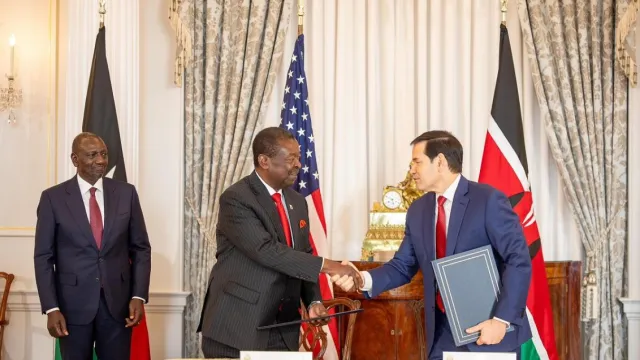
In Washington, D.C., in the United States, President William Ruto (left) witnesses the signing of the Kenya–US Health Cooperation Framework, signed by Secretary of State Marco Rubio and Prime Cabinet Secretary Musalia Mudavadi (centre). The United States will commit US$1.6 billion to Kenya over the next five years through government institutions in the healthcare sector.
President William Ruto's administration's push to start sharing critical data on health of wananchi has been dealt a body blow after the High Court suspended implementation of key provisions of the pact citing potential breach of data privacy.
Justice Bahati Mwamuye, sitting in Mombasa, issued a conservatory order stopping the government from operationalising any section of the deal that provides for the transfer, sharing or dissemination of medical, epidemiological or personal health data to the United States.
Related
Govt scrambles for Sh25 billion after USAID pulls out

“A conservatory order is hereby issued suspending, staying and restraining the respondents, whether by themselves, their agents or assigns, from implementing, operationalising or howsoever giving effect to the Health Cooperation Framework between the Republic of Kenya and the United States of America dated December 4, 2025, in so far as it provides for or facilitates the transfer, sharing or dissemination of medical, epidemiological and sensitive personal health data,” ruled the judge.
His directives follows a petition filed by the Consumers Federation of Kenya (COFEK), which argued that the Kenya-US agreement was concluded without adequate public participation and failed to consider constitutional safeguards on privacy and data protection.
"Decision-making informed by Kenyan health data must be public, auditable and jointly supervised, with consumer representatives involved in data processing, monitoring and evaluation, and independent oversight," the federation said in a statement.
The judge further directed that the matter be mentioned on February 12, 2026, before Justice Lawrence Mugambi for compliance and further directions aimed at fast-tracking the hearing of the petition.
The contested agreement, signed in Washington, D.C. by Prime Cabinet Secretary Musalia Mudavadi and U.S. Secretary of State Marco Rubio, outlines a five-year cooperation framework valued at approximately KSh208 billion.
It seeks to enhance Kenya’s disease surveillance, support infectious disease control programmes, improve maternal and child health outcomes, and strengthen emergency response systems.
COFEK, however, contends that the government did not subject the agreement to the constitutional requirement of parliamentary approval for treaties and international obligations that impact national interests.
The organisation further claims that the data-sharing provisions risk exposing millions of Kenyans’ sensitive health information to foreign jurisdictions with limited oversight from local regulators.
“This exposes citizens to lasting privacy violations of, stigma and potential misuse of their information. The irreversible nature of the harm elevates the urgency of the matter,” argued COFEK.
In its petition, the federation cites alleged violations of Article 31 of the Constitution, which guarantees the right to privacy, and argues that the government may have acted contrary to the Data Protection Act, the Digital Health Act, and national regulations governing the cross-border transfer of personal data.
According to COFEK, transferring any form of identifiable or sensitive health data outside the country could result in irreversible breaches of confidentiality. The group maintains that the health cooperation pact should not proceed until adequate data safeguards, transparency mechanisms and public consultations have been conducted.
The government, through various statements issued earlier, has defended the agreement and insisted that the cooperation framework does not endanger citizens’ privacy. Officials have maintained that any data shared under the programme would be strictly de-identified, aggregated and compliant with Kenyan law.
They further argue that the agreement is essential to building Kenya’s public health capacity, citing ongoing partnerships in fighting HIV/AIDS, malaria, tuberculosis and other infectious diseases, as well as support for emerging health threats and disaster preparedness initiatives.
Notably, Justice Mwamuye’s ruling does not suspend the entire pact. Instead, it places a temporary freeze on the specific sections dealing with health and personal data transfer, allowing the rest of the cooperation framework to exist but not to be implemented in any way that involves sharing sensitive information.
However, the decision comes at a time when Kenya is increasingly entering multilateral and bilateral digital-health partnerships, raising questions about how the country navigates the tension between global health cooperation and the protection of citizens’ constitutional rights.
The case will proceed to a full hearing next year, where the court is expected to determine whether the government followed all constitutional and statutory requirements in signing the agreement, and whether the data-related clauses pose any legitimate threat to privacy.