Kenya readies Africa Capital Week to address continent's $402bn infrastructure gap
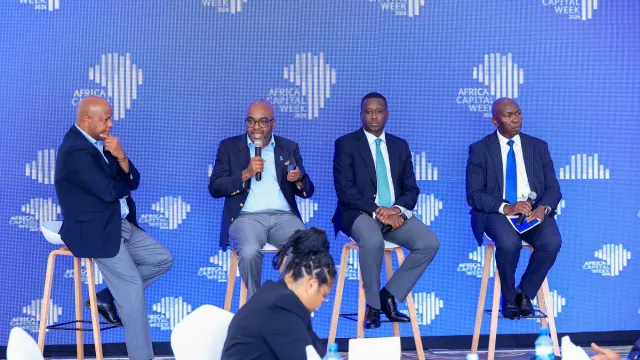
From left, Dr. Emmanuel Nzai, Chairman VDB and Africa Capital Week 2026, Mr. Willie Njoroge CEO, KASIB, Mr. Daniel Mainda, CEO NIFC and Mr. Wyckliffe M. Shamiah, CEO CMA on a panel discussion during the official launch of the Africa Capital Week 2026 set to happen from 31st August to 4th September. The launch was at The Kenya School of Monetery Studies in Nairobi.
Kenya has unveiled plans to host the inaugural Africa Capital Week, a five-day forum scheduled for 31 August to 4 September in Nairobi, as the country positions itself as the convenor of what organisers describe as the continent’s first capital markets forum built entirely around mobilising investment at scale.
The forum will draw institutional investors, fund managers, development finance institutions, sovereign wealth funds, regulators and policymakers from across Africa and around the world to advance the mobilization of capital for the continent's development priorities.
Related
Diageo-Asahi deal secures historic nod from EA capital markets regulators
CMA approves three investment bank licenses in capital markets overhaul

Organizers said the five-day showcase will bring together high-level plenary sessions on continental capital markets policy, technical sessions across asset classes and market infrastructure and structured investor matchmaking across priority sectors.
Additionally, Africa Capital Week is structured to feature project site visits, taking delegations directly to investment-ready projects on the ground to enable first-hand assessment of investment opportunities.
The initiative, which was launched at a high-level breakfast, brings together the Capital Markets Authority, the Vision 2030 Delivery Secretariat, the Nairobi Securities Exchange, and the Nairobi International Financial Centre to roll out the plan.
Government officials, private sector leaders and development partners attended the launch, including Principal Secretary Bonface Makokha and Vision 2030 Chairman Dr Emmanuel Nzai.
Infrastructure financing gap
The organizers argue that Africa faces an infrastructure financing gap estimated at $402 billion annually, yet the continent’s capital markets remain undersized relative to both its financing needs and its economic scale.
Data shows that African equity markets have grown roughly twenty-sevenfold over two decades to around $560 billion, but more than 80 percent of that capitalisation is concentrated in South Africa, Morocco and Egypt.
Institutional barriers, thin secondary markets and fragmented regulatory frameworks across borders have kept domestic capital from flowing efficiently to where it is needed most.
The forum is pitched as the venue where that imbalance will be confronted directly, with tracked outcomes intended to include activated investment pipelines, policy commitments and cross-border capital flow frameworks.
Kenya is staking its case to host on a clear rebound in its own capital markets. The NSE 20 Share Index climbed 59.9 percent to 3,491 points in May 2026, up from 2,183 points a year earlier.
Market capitalisation expanded 61.6 percent to KSh 3.4 trillion from KSh 2.1 trillion over the same period, lifted by stabilising macroeconomic conditions and a return of activity after a multi-year listing drought.
“Africa Capital Week is not simply about raising capital. It is about building confidence. It is about connecting opportunity with investment. It is about transforming ambition into action.
And ultimately, it is about securing Africa's economic future through stronger capital markets and sustainable investments,” said Cyrell Wagunda Odede, Principal Secretary, state department for public investments and assets management.
The push has been informed by Kenya’s ambition to mobilise funds for critical development projects, underpinned by the formation of the Sovereign Wealth Fund and the National Infrastructure Fund, both aimed at channeling institutional and retail capital into commercially viable projects.
New product classes
Organisers have framed the launch against the just-concluded 2026/27 National Budget, which carried several measures aimed at deepening the market.
These include the formal trading of carbon credits, the exemption of foreign investors from KRA PIN requirements solely to open Central Depository and Settlement Corporation accounts and trade on the NSE, and new product classes including virtual assets and Sukuk.
Representatives of the National Black Chamber of Commerce told the meeting the organisation has mobilised close to $1 billion ready for deployment into viable projects.
“Africa has not had a forum of this standing dedicated entirely to its capital markets,” said Nzai, convenor of the forum.
“Africa Capital Week will be where the continent’s financing agenda is set, where investor relationships that move capital across borders are built, and where the narrative about what African markets can deliver is written by those who are building them," he added.