What happens to your M-PESA account balance when you die?
When one dies, MPESA-based loans such as Fuliza and M-Shwari also get to end of life
There’s an old expression that says “You can’t take it with you.”
In layman’s terms what this means is that you can’t take any of your possessions with you when you die.
Related
Kenyans love for giving, how the harambee spirit lives on M-PESA

From your family members to your closest friends, money, valuables, everything is left here on earth—even your M-PESA balance.
For other financial services like banks, stocks, insurance, unit trusts e.t.c, there is a sort of knowledge of where your money goes after you die.
So, it begs the question, what happens to your M-PESA when you die?
When you die, your M-PESA account doesn’t disappear—but the money inside it doesn’t automatically go to your loved ones either.
Here is the simple procedure: First, the family needs to inform Safaricom about the death of the owner of the M-PESA account.
“So if the person passes, the family member or the assigned next of kin will need to come and inform Safaricom and inquire about their balance. You need to write a letter indicating your name and your relationship to the deceased and your request,” said Selline Akoth, Retail Operations Lead, Safaricom.
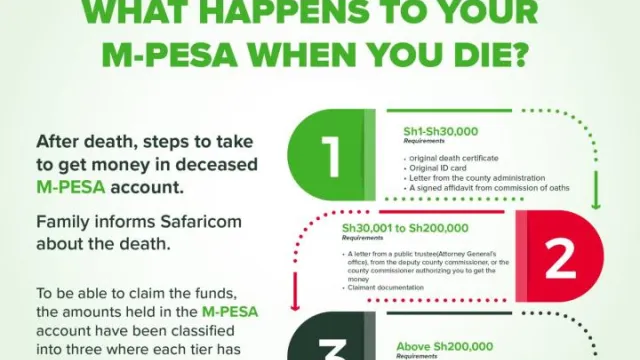
To be able to claim the funds, the amounts held in the M-PESA account have been classified into three where each tier has different requirements.
The first is between Sh 1 to Sh30,000 where you need the original death certificate, original ID card, and a letter from the county administration.
“So that administration, we have the chief, we have the Assistant Chief, we have the County Commissioner and Deputy county commissioner, so they give you a letter where they must indicate that you’re the one who is going to get the resources, and they’ll indicate your details, your name, your contacts and relationship to the deceased.”
“And then they’ll also be a signed affidavit from commission of oaths accompanying that to indemnify Safaricom,” said Selline.
The second classification is money between Sh30,001 to Sh200,000.
To claim this, the Safaricom team needs a letter from a public trustee(Attorney General’s office), from the deputy county commissioner, or the county commissioner authorizing you to get the money, plus claimant documentation.
Then if it’s above Sh200,000 that is treated as full succession, where Safaricom will need a grant of probate or a letter of administration, to give the claimant access to the funds.
The procedure of applying for a grant of probate in Kenya is governed by the Law of Succession Act (Cap 160) and the Probate and Administration Rules.
In Kenya, the time it takes to obtain a grant of probate can vary, but it typically takes several months, potentially extending to years depending on the complexity of the estate and whether there are any disputes.
There’s a time limit of 2 years to claim the money from Safaricom, after that the money goes to the Unclaimed Financial Assets Authority (UFAA).
In all the scenarios, the Service Level Agreement (SLA) allows the claimant to get the money 24 hours after submission of documents.
Key to note is that even if the deceased line goes into expiry status, the funds held in their M-PESA account don’t expire. UFAA holds them.
But for loans such as Fuliza and M-Shwari, those get to end of life.
Something that many people might think to do when someone close to them passes away is to withdraw the money instead of going through this process.
This seems okay, however, it is a crime. Agent withdrawal requires presentation of the original ID of the registered owner vetted against the person withdrawing.
“Safaricom doesn’t authorise the next of kin to withdraw money for the deceased because you’re not the user. It is criminal because that is not your money, and that money should go to the next of kin through the right way, succession,” said Selline.