Kenyan regulators press listed firms to speed up sustainability reporting ahead of deadline
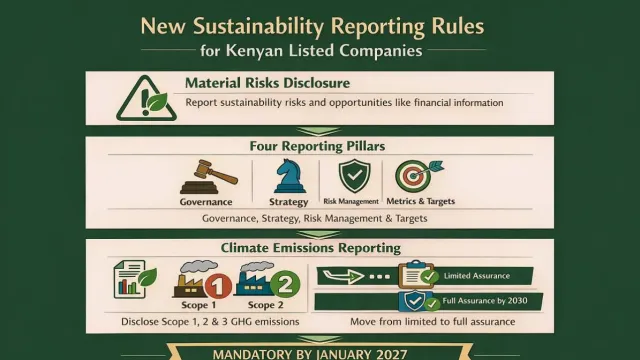
Starting 2027, sustainability reporting will no longer be a voluntary practice but a regulatory requirement for all Nairobi Securities Exchange-listed firms.
Industry regulators in Kenya have stepped up the pressure on listed companies to prepare for global sustainability reporting rules, as the clock ticks towards mandatory disclosure from January 2027.
In a joint advisory issued on Friday, 17th April, the Institute of Certified Public Accountants of Kenya (ICPAK), which regulates the accounting profession in Kenya, and the Nairobi Securities Exchange (NSE) urged issuers to accelerate alignment with the International Financial Reporting Standards for sustainability, IFRS S1 and IFRS S2.
Related
Calls intensify for listed firms to step up on sustainability reporting

Absa sets the pace on new sustainability reporting standards for NSE firms

This industry-wide guidance marks a significant shift in sustainability reporting and enforcement for companies operating in East Africa’s largest economy. For NSE-listed firms, sustainability reporting is no longer a voluntary practice but a regulatory requirement.
“Listed issuers are expected to undertake a Sustainability Reporting Readiness Assessment ahead of the first reporting cycle,” the advisory stated in part, adding that material sustainability risks must be disclosed in line with existing rules on price-sensitive information.
The regulators were explicit. Sustainability disclosures are no longer separate. They form part of core market obligations.
Full reporting cycle
In Kenya, voluntary adoption of sustainability reporting started in January 2024. According to the latest directive, however, mandatory reporting for listed companies will start in January 2027. That leaves less than a year for firms to prepare for the first full reporting cycle.
The focus, regulators say, is not compliance alone. It is market integrity. Climate and environmental risks that could influence investor decisions must be treated in the same way as financial risks.
The guidance embeds sustainability reporting within continuous disclosure requirements. Companies will be expected to flag material environmental and social risks as market-moving information.
Issuers must carry out structured readiness assessments. These should cover governance, strategy, risk management and metrics, a framework that effectively mirrors the global IFRS best practices.
In this new dispensation, company boards will be expected to show oversight. Executives must demonstrate accountability. Companies must also explain how sustainability risks affect business models and long-term resilience.
The exchange has asked issuers to submit readiness assessments at least six months before their first reporting period. These will be reviewed as part of ongoing regulatory supervision.
Independent assurance
Attention is also turning to verification. Sustainability disclosures will be subject to phased independent assurance. Initial reporting will require limited assurance, before moving to reasonable assurance in the subsequent years.
“Sustainability disclosures for listed issuers will be subject to independent assurance on a phased basis,” the advisory explained, urging companies to strengthen internal controls, documentation and data systems.
The timetable is incremental but firm. Limited assurance is expected to begin in 2028 with full reasonable assurance forecast to enter into force by 2030.
Only licensed professionals will be allowed to provide assurance. They must demonstrate expertise in sustainability reporting and remain independent of the companies they audit.
Regulators are pushing for early action. Firms are advised to engage assurance providers by mid-2026 to allow time to build systems and test controls.
Climate disclosures sit at the centre of the new reporting regime. Companies will be required to report greenhouse gas emissions across Scope 1, Scope 2 and Scope 3 — covering direct, energy-related and value chain emissions.
Measurement must follow recognised international methodologies, including those developed by the Intergovernmental Panel on Climate Change and the International Energy Agency.
The advisory also stresses “connectivity”, indicating that a company’s sustainability disclosures must align with financial statements. Firms will need to show how environmental and social risks affect capital allocation, performance and forward-looking assumptions.
The push reflects a broader shift in global markets. Investors are demanding clearer links between sustainability and enterprise value.
Kenya’s regulators appear determined to keep pace. The NSE has already issued ESG guidance for listed companies. While not mandatory, it has set a baseline.
Key takeaways: What new sustainability rules mean
- Companies must disclose material sustainability risks and opportunities as part of core market reporting, treating them like price-sensitive financial information.
- Firms are required to report across four pillars: governance, strategy, risk management, and metrics and targets.
- Mandatory climate disclosures will include greenhouse gas emissions across Scope 1, Scope 2 and Scope 3 using recognised global methodologies.
- Sustainability reports must be aligned with financial statements, showing how environmental and social risks affect performance, capital allocation and future assumptions.
- Disclosures will be subject to phased independent assurance, moving from limited assurance to full reasonable assurance by 2030.