High global oil prices, China imports widen Kenya’s trade deficit to Sh214bn
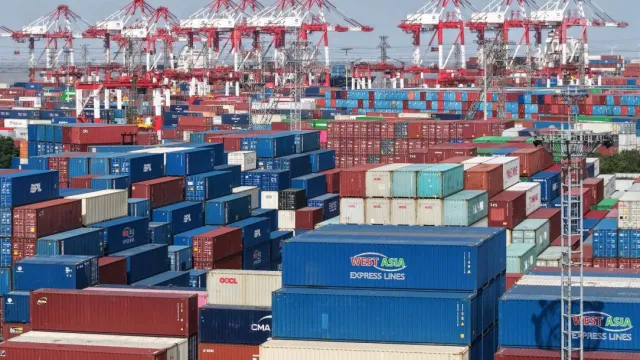
Kenya's September trade deficit deterioration was primarily driven by imports, which increased by 20.9 percent to KES344.2 billion while the value of exports expanded by modest 9.5 percent to KES128.2 billion.
Kenya’s trade deficit rose sharply in September, hitting KES214.9 billion as stubbornly high oil prices in the global markets and uptick in imports from China worsened the country’s external position, statistics from the Kenya National Bureau of Standards show.
During the month under focus, KNBS statistics show that OPEC Reference Basket increased from $86.44 per barrel in August to $110.59 per barrel in September, a 28 percent increase in a single month.
Related
Kenya's private sector contracts as war in the Middle East hits demand, input costs

Iran war threatens to wipe out Kenya's Sh164Bn Gulf exports

That spike is already feeding through to Kenyan consumers. The national average retail price of petrol stood at KES 214.95 per litre in September, diesel at KES 219.04 per litre, and kerosene at KES 192.56 per litre.
The oil price shock helped push annual inflation to 6.76 per cent in September, up from 6.59 per cent in August, a 0.17 percentage point increase, as the Consumer Price Index rose 0.4 per cent month-on-month to 156.47.
According to KNBS, the country’s gap between imports and exports widened from KES166.7 billion recorded in August.
September’s deterioration was primarily driven by imports, which increased by 20.9 percent to KES344.2 billion while the value of exports expanded by modest 9.5 percent to KES128.2 billion.
During the month, China cemented itself as the primary source of imports for Kenya, as the value of goods from Beijing went up by 35.9 percent to KES113.2 billion compared to KES83.3 billion worth of products secured in August.
At the same time, India, which has remained Kenya’s second-largest source of supplies, experienced a 19.4 percent dip in imports to KES51.8 billion while KES21.9 billion worth of imports from the U.S. were recorded.
Kenya’s exports to the United States more than doubled to KES 27.9 billion from KES 12.0 billion in August, making Washington the country’s leading export destination. Uganda followed at KES 13.2 billion and Pakistan at KES 6.4 billion.
By broad economic category, food and beverages accounted for the largest share of domestic exports at 36.0 percent, followed by machinery and other capital equipment at 22.9 percent, and industrial supplies at 18.2 percent.
The agricultural sector saw offee exports jump by 27.7 percent to 5.1 thousand metric tonnes in September, with the value of exports rising to KES 5.1 billion from KES 3.9 billion in August.
Cumulatively, coffee exports reached 50.8 thousand MT in the first nine months of 2026, compared with 45.2 thousand MT in the same period of 2025, while export value rose to KES 50.7 billion from KES 43.4 billion.
Tea exports declined marginally to 49.89 thousand MT from 49.94 thousand MT, but the value of exports rose to KES 14.82 billion from KES 14.79 billion. Cumulatively, tea export volumes fell to 472.9 thousand MT from 479.5 thousand MT, even as the value increased to KES 140.7 billion from KES 134.9 billion.
The horticulture sector posted weaker performance with cut flower exports declining to 12.1 thousand MT from 12.5 thousand MT, with earnings dropping to KES 7.7 billion from KSh 8.6 billion.
Fruit exports dropped sharply to 12.9 thousand MT from 19.6 thousand MT, with earnings falling to KeS 3.5 billion from KES 5.2 billion. Vegetable exports declined in volume to 14.5 thousand MT from 16.4 thousand MT, though earnings rose slightly to KES 3.07 billion from KES 3.01 billion.
Sugar-cane deliveries fell by 6.9 percent to 878.7 thousand MT in September from 943.8 thousand MT in August, and sugar production declined by 6.7 percent to 78.0 thousand MT. Formal-sector milk intake also dropped 5.4 percent to 74.8 million litres.
Kenya’s electricity grid remains one of the cleanest in Africa. Geothermal was the leading source of local generation in September, rising 1.5 percent to 575.1 million kWh and accounting for 46.4 per cent of the total. Hydro generation fell 10.4 percent to 306.2 million kWh (24.7 percent), while wind rose 5.0 per cent to 224.1 million kWh and solar increased 7.4 per cent to 42.4 million kWh. Thermal generation rose 5.7 per cent to 92.3 million kWh.
Total electricity supply nevertheless declined 2.5 per cent to 1,361.3 million kWh, as imports fell to 121.1 million kWh from 147.6 million kWh and exports plunged to 3.2 million kWh from 19.0 million kWh.
The construction sector showed clear signs of cooling. The value of building plans approved by Nairobi City County halved to KES 18.1 billion in September from KES 31.8 billion in August. Residential building plans plunged 49.2 per cent to KES 14.1 billion, while non-residential approvals edged up 0.5 percent to KES 4.0 billion. Cement production fell 1.7 per cent to 1,036.4 thousand MT.