Nairobi’s financial centre certification targets AI, virtual assets firms
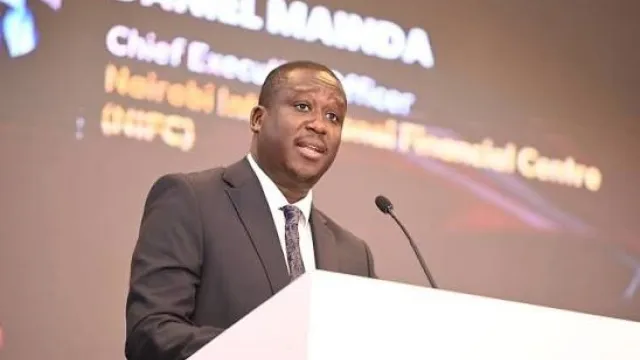
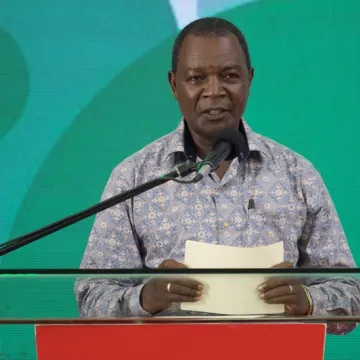
NIFC Chief Executive Daniel Mainda.
The Nairobi International Financial Centre (NIFC) has certified 15 new companies, a move that projects over $200 million in investment and the creation of over 1,000 jobs in emerging segments such as digital assets and climate finance.
In a market update on June 30th, NIFC is putting to the test Kenya’s ambition to transform itself from just a regional hub into Africa’s key entry platform for capital from around the world.
Related
Nairobi International Financial Centre makes bold step onto world stage

Kenya seeks IMF aid to escape money laundering 'grey list'
The newly certified cohort includes Bupa Global Insurance, carbon project developer Giraffe Bioenergy, AI firm ReportsAI and notably, Africa First Exchange (A1X) and Valor (Valr) Capital, both signalling Nairobi's deepening interest in digital assets and tokenised securities.
According to NIFC Chief Executive Daniel Mainda, the latest certifications points to a collective vote of confidence in Kenya’s evolving regulatory environment, stating, “we are building Africa’s premier ecosystem for global capital”.
“We are not simply attracting firms; we are building Africa's premier ecosystem for global capital. An ecosystem where funds are domiciled, startups scale into regional champions, digital assets are responsibly regulated, carbon markets mature, innovation is financed and international investors choose Nairobi as their gateway to the continent. Every certification strengthens that vision and brings Nairobi closer to becoming Africa's financial gateway and one of the world's most competitive international financial centres.”
Notably, the drift towards attracting players in the fast evolving digital assets space stands out given the high risk involved at a time when the country is putting in place core guard rails in this segment.
Kenya's Virtual Asset Service Providers (VASP) Act, which was passed in late 2025 and the subsequent draft laws published in March 2026, are slowly transitioning Nairobi from a regulatory grey area to a formal trading environment.
Kenya's virtual assets environment
Under the new framework, stablecoin issuers face a minimum capital requirement of KSh500 million or $3.8 million, while exchanges and tokenisation platforms must hold KSh150 million and Sh200 million respectively.
These checks are designed to attract institutional-grade players and mitigate money-laundering risks, which has been a primary driver given Kenya’s grey-listing by the FATF in February 2024.
Additionally, the inclusion of firms such as AlphaBloq Technologies and OwnMali in the Capital Markets Authority’s regulatory sandbox earlier this year, specifically for real estate tokenisation, suggests a regulator willing to sanction innovation within a controlled perimeter.
However, the "twin peaks" model, where the Central Bank of Kenya oversees stablecoins and payments while the Capital Markets Authority governs exchanges and tokenisation, risks creating friction.
Business models that blur these lines could face overlapping expectations, a "compliance burden" that industry stakeholders have already warned could stifle local start-ups in favour of well-capitalised foreign entrants.
Beyond digital assets, the NIFC is leveraging geopolitical partnerships. The latest wave of certification highlights cooperation agreements with the Qatar Financial Centre, the Astana International Financial Centre and Casablanca Finance City.
While these agreements build connectivity corridors, they also strategically position Nairobi not just as a domestic hub, but as a node in a wider network of Islamic and emerging market finance.
This is reinforced by Kenya’s successful bid to host the Secretariat of the Alliance of African Multilateral Financial Institutions (AAMFI). Hosting the secretariat places Nairobi at the centre of collaboration among institutions such as the Africa Finance Corporation and Afreximbank, potentially influencing continental financial policy.