CEOs flag geopolitical risks and cost pressures in CBK survey
CEOs in Kenya are increasingly concerned about high cost of doing business amid rising tension in the Middle East, a key source for petroleum energy supplies.
The captains of industry in Kenya have raised concern over the negative impacts of geopolitical headwinds, runaway costs on inputs and persistent mixed signals in domestic demand, the latest survey by the Central Bank shows.
While chief executive officers remain cautiously optimistic about the country's economic trajectory for the next one year, CBK's July survey shows the CEOs are increasingly concerned about high cost of doing business amid rising tension in the Middle East, a key source for petroleum energy supplies.
Related
Kenya's private sector contracts as war in the Middle East hits demand, input costs

Iran war threatens to wipe out Kenya's Sh164Bn Gulf exports

The survey, which sought views from over 1,000 CEOs shows that the prospects of growth by many companies have improved, attributable to increasing demand in the market, product diversification and rising deployment of technology.
However, the industry chiefs decry of subdued demand in some months, sky-high operating costs due to increasing energy prices and the persistent wave of uncertainty across the globe largely due to the Middle East crisis.
CBK said a majority of CEOs expect global economic growth to weaken over the next 12 months, citing the conflict in the Middle East, higher energy prices, and inflationary pressures as key drivers.
Despite this, a larger proportion of CEOs remain optimistic about the resilience of the Kenyan economy, buoyed by expectations of a recovery in agriculture, a stable financial sector and ongoing digitisation.
The survey highlights geopolitical developments as the primary external threat to business activity. Tensions in the Middle East were identified as a major source of disruption, pushing up fuel and freight costs and straining supply chains.
This concern eclipses even the impact of U.S. trade tariffs and policy changes, which were also flagged as a significant external risk, increasing import and production costs, with knock-on effects for tourism, donor funding and government financing.
"U.S. trade tarriffs and other policy changes are expected to increase trade and supply chain pressures, import and shipping costs, and production costs, while negatively affecting tourism and travel, donor funding and foreign aid, particularly for the health sector and government financing," CBK survey noted in part.
The findings also suggest some silver linings: the de-escalation of tensions in the Middle East is expected to have a moderately positive effect by lowering energy costs, while continued benefits from the African Growth and Opportunity Act (AGOA) are expected to support trade.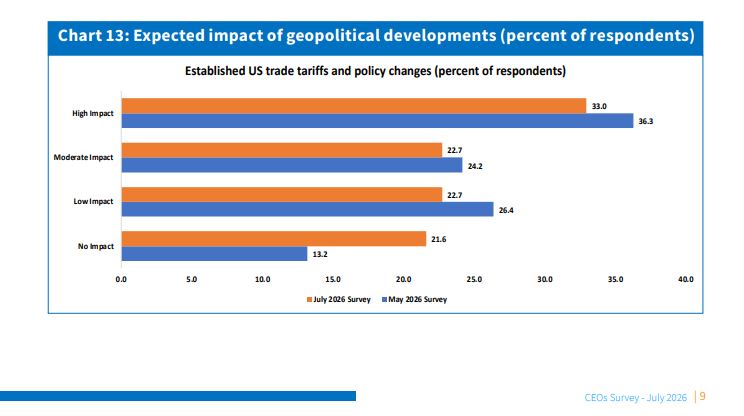
Domestic costs
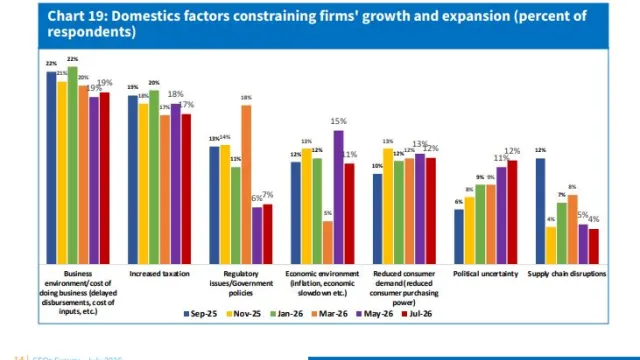
On the domestic front, the cost of doing business remains the leading constraint to firm expansion, with rising fuel, energy and input costs key pain points.
Additionally, weak consumer purchasing power due to inflation and supply-chain disruptions continuing to weigh on business activity, therefore, squeezing margins.
In response to these pressures, companies are increasingly integrating technology to improve operational efficiency and manage costs. Some of the key initiatives cited include automation, use of digital payments and cloud-based solutions to drive efficiency.
What's more, CEOs are deploying AI-enabled systems to enhance customer service and reduce manual processes.
The adoption of technology, coupled with a customer-centric approach, improving product portfolios, and reassessing business models, has been cited as the key driver of sectoral growth over the next 12 months.
To mitigate the constraining factors, firms are focusing on cost and risk management, diversifying operations, and expanding into new markets.
The survey indicates that business activity in the second quarter of 2026 was mixed compared to the first quarter. While a recovery was noted in demand orders, production volumes, and sales—supported by better access to credit and lower lending rates—these gains were offset by rising costs and weaker consumer purchasing power.
Looking ahead to the third quarter, business activity is expected to remain broadly stable. Most firms reported operating below or near full capacity, suggesting they have the capacity to accommodate an unexpected increase in demand. This is supported by efforts to expand production through process optimisation and system improvements, alongside the availability of casual labour to meet staffing needs.