KCB Group’s loans to agriculture sector rise to Sh75 billion
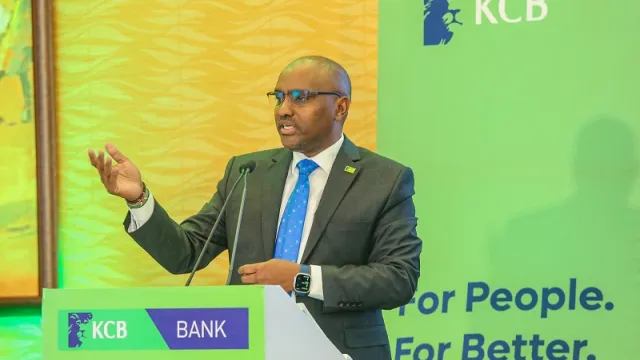
KCB Group Chief Executive Paul Russo. The lender's green loans increased to 25.8% of the total loan portfolio, surpassing the Group’s initial target of 25% by 2025.
Kenya’s leading commercial bank by assets KCB Group has lent Sh75.4 billion in credit to the region’s agricultural sector as the lender pushes through with its strategy to fund climate resilient agriculture.
Data from the firm’s latest financial reports indicate that the credit it advanced to the agricultural sector stood at Sh75.4 billion last year, a 50 percent increase from Sh50.6 billion recorded in 2024.
Related
KCB cuts carbon footprint, screens Kes336 billion in green loans
KCB Group deepens sustainable finance with Sh53.2Bn in green loans
This makes the firm one of the region’s largest credit providers to the agricultural sector and also comes at a time when increased uncertainty over climate-related shocks and disruptions in global supply chains have put the livelihoods of millions of farmers in precarity.
According to the firm, the credit outlay in recent months is in line with ambitions to expand its lending portfolio going to sustainable finance, with a quarter of its loan book now directed at green financing.
“In 2024, KCB disbursed KSh53.2 billion in green financing,” explained the firm’s management in recent financial reports.
“This momentum was sustained in 2025, with an additional KSh48.8 billion disbursed across key sectors such as renewable energy, climate-smart agriculture, and clean transport. As a result, green loans increased to 25.8% of the total loan portfolio, surpassing the Group’s initial target of 25% by 2025.”
Agricultural transformation
KCB Group’s focus on creating sustainable agricultural value chains comes at a time when both the public and private sectors are aggressively seeking avenues to increase productivity in a traditionally precarious sector, particularly for small holder farmers who form the bulk of the industry.
Earlier this year, the Kenyan government launched the National Agri-food Systems Investment Plan (NASIP), an ambitious strategy to marshal more than Sh1 trillion in financing over the next five years from taxpayers, the private sector and development partners to stimulate the country’s agricultural transformation.
Key spending priorities include Sh265 billion to improve agro-industrialisation and value addition, Sh191 billion to boost financing for the sector, Sh111 billion for research, data and innovation and Sh190 billion to enhance medium-to-large scale production and irrigation.
The government says it is banking on a blended set of financing options and instruments to mobilise resources efficiently, mitigate risks and promote accountability.
“Blended finance combines public, concessional, and private resources to de-risk investments and scale high-impact projects,” explains the Ministry of Agriculture in its project outline. “NASIP leverages these tools to address barriers like high perceived risks in agriculture, aiming to mobilize at least 45% of total funding from private sources by 2030.”
If successful, the plan will help grow the agricultural sector that has in recent years experienced a deceleration in gross value added (GVA).
According to data from the Kenya National Bureau of Statistics, KNBS, real agricultural growth rate stood at 2.8 percent last year, down from 4.3 percent in 2024and 7.1 percent in 2023 with economists attributing the drop to adverse weather patterns.
“Growth in the agricultural sector slowed down in 2025 compared to growth in 2024,” explained the statistics office in the latest edition of the Economic Survey.
“While the sector continued to expand in real terms, the slowed increase in real GVA points to a sector that experienced adverse weather during the review period,” said the KNBS. “Consequently, the agricultural sector continued to decelerate for a second consecutive year.”
This has led policy-makers and industry players across the board to push for a proposition that takes into account the financing needs of the entire value chain. This means more than direct lending to farmers and also providing capital finance to companies that provide inputs, facilitate production, processing and trade financing to agricultural exporters.
In recent years KB Group has been at the center of providing corporate financing solutions to entities that form the building blocks of this vast agro-processing value chain.
This includes through providing a Sh2 billion financing to support fertilizer imports under the state fertilizer subsidy programme and a Sh4.5 billion facility for Itracom Fertilizer Limited which produces and distributes organic fertilizer across the region.
KCB Group was also instrumental in providing Sh34 billion in working capital and trade-finance support to the Kenya Tea Development Agency, KTDA and Chai Trading Company.
The lender also provides financing for several milk producers including Brookside, Githunguri Dairy, Meru Dairy and Mukurweini Wakulima Dairy as well as a Sh514 million facility for Meru Maziwa Millers.
Last month the firm launched a framework for green, blue, social and sustainability bonds that seeks to raise Sh300 billion over the next five years. A big chunk of the funds will be directed at the agricultural sector, with financing directed towards areas such as water and input efficiency, crop and climate resilience and post-harvest and food loss reduction.
This article was first published on Citizen Digital